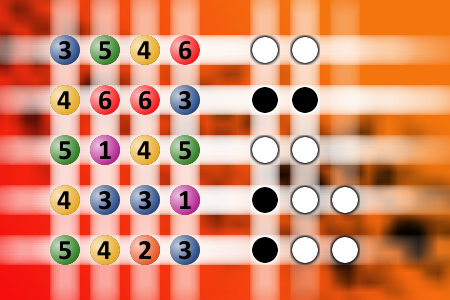
Which is a winning combination of digits?
[7634] Which is a winning combination of digits? - The computer chose a secret code (sequence of 4 digits from 1 to 6). Your goal is to find that code. Black circles indicate the number of hits on the right spot. White circles indicate the number of hits on the wrong spot. - #brainteasers #mastermind - Correct Answers: 3
BRAIN TEASERS
enter your answer and press button OK

Which is a winning combination of digits?

The computer chose a secret code (sequence of 4 digits from 1 to 6). Your goal is to find that code. Black circles indicate the number of hits on the right spot. White circles indicate the number of hits on the wrong spot.
Correct answers: 3
#brainteasers #mastermind
Register with your Google Account and start collecting points.
Check your ranking on list.

Women pleasing dog

A man walks into a bar with his dog and orders two glasses of whiskey. He proposes a toast and both he and his dog empty their glasses.

The girl behind the bar is surprised and asks, 'Can your dog perform other tricks?'.

'But of course', the man answers, 'he can even gratify a woman'.

Anxious to know more the girl leads the man and the dog into a little room above the bar. She undresses and full of expectation she lies down on the bed.

The dog looks at her and does nothing.

'It's always the same thing with you!', the man then shouts at the dog, 'Ok, I'll show you how to do this one last time'.

Jokes of the day - Daily updated jokes. New jokes every day.
Follow Brain Teasers on social networks

Brain Teasers

puzzles, riddles, mathematical problems, mastermind, cinemania...

Blue moon

In 1982, a second full moon of the month was visible. Known as a "blue moon," the name does not refer to its colour, but it is a rare event, giving rise to the expression, "once in a blue moon" came from. This blue blue moon was more special as a total lunar eclipse also occurred (U.S.). Although there were 41 blue moons in the twentieth century, this was one of four during an eclipse of the moon, and the only total eclipse of a blue moon in the twentieth century. A blue moon happens every 2.7 years because of a disparity between our calendar and the lunar cycle. The lunar cycle is the time it takes for the moon to revolve around the earth, is 29 days, 12 hours, and 44 minutes.
This site uses cookies to store information on your computer. Some are essential to help the site properly. Others give us insight into how the site is used and help us to optimize the user experience. See our privacy policy.