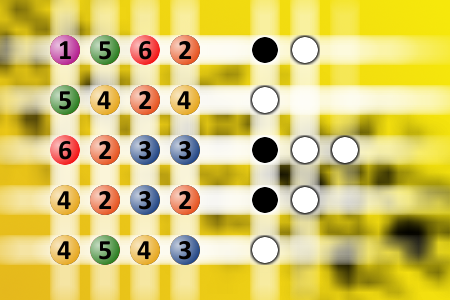
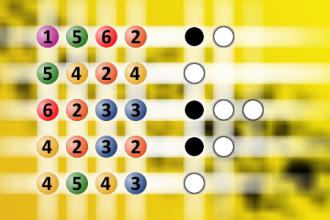
Which is a winning combination of digits?
[8113] Which is a winning combination of digits? - The computer chose a secret code (sequence of 4 digits from 1 to 6). Your goal is to find that code. Black circles indicate the number of hits on the right spot. White circles indicate the number of hits on the wrong spot. - #brainteasers #mastermind - Correct Answers: 0
BRAIN TEASERS
enter your answer and press button OK

Which is a winning combination of digits?

The computer chose a secret code (sequence of 4 digits from 1 to 6). Your goal is to find that code. Black circles indicate the number of hits on the right spot. White circles indicate the number of hits on the wrong spot.
Correct answers: 0
#brainteasers #mastermind
Register with your Google Account and start collecting points.
Check your ranking on list.

Service for Your Dog

A farmer named Muldoon lived alone in the Irish countryside except for a pet dog he for a long time.

The dog finally died and Muldoon went to the parish priest, saying "Father, the dog is dead. Could you possibly be saying a Mass for the poor creature?"

Father Patrick told the farmer "No, we can't have services for an animal in the church, but I'll tell you what, there's a new denomination down the road apiece, and no telling what they believe in, but maybe they'll do something for the animal."

Muldoon said "I'll go right now. By the way, do you think $50,000 is enough to donate for the service?"

Father Patrick replied "Why didn't you tell me the dog was Catholic."

Jokes of the day - Daily updated jokes. New jokes every day.
Follow Brain Teasers on social networks

Brain Teasers

puzzles, riddles, mathematical problems, mastermind, cinemania...

Cecil Frank Powell

Born 5 Dec 1903; died 9 Aug 1969 at age 65.English physicist who was awarded the Nobel Prize for Physics in 1950 for his development of the photographic method of studying nuclear processes and for the resulting discovery of the pion (pi-meson), a heavy subatomic particle. The pion proved to be the hypothetical particle proposed in 1935 by Yukawa Hideki of Japan in his theory.
This site uses cookies to store information on your computer. Some are essential to help the site properly. Others give us insight into how the site is used and help us to optimize the user experience. See our privacy policy.