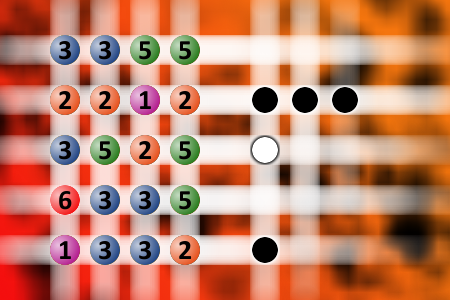
Which is a winning combination of digits?
[8423] Which is a winning combination of digits? - The computer chose a secret code (sequence of 4 digits from 1 to 6). Your goal is to find that code. Black circles indicate the number of hits on the right spot. White circles indicate the number of hits on the wrong spot. - #brainteasers #mastermind - Correct Answers: 1
BRAIN TEASERS
enter your answer and press button OK

Which is a winning combination of digits?

The computer chose a secret code (sequence of 4 digits from 1 to 6). Your goal is to find that code. Black circles indicate the number of hits on the right spot. White circles indicate the number of hits on the wrong spot.
Correct answers: 1
#brainteasers #mastermind
Register with your Google Account and start collecting points.
Check your ranking on list.

The # 1 April Fools Prank of All Time - The Swiss Spaghetti Harvest

April 1, 1957: The respected BBC news show Panorama announced that thanks to a very mild winter and the virtual elimination of the dreaded spaghetti weevil, Swiss farmers were enjoying a bumper spaghetti crop.

It accompanied this announcement with footage of Swiss peasants pulling strands of spaghetti down from trees. Huge numbers of viewers were taken in.

Many called the BBC wanting to know how they could grow their own spaghetti tree. To this the BBC diplomatically replied, 'place a sprig of spaghetti in a tin of tomato sauce and hope for the best.'

Even the director-general of the BBC later admitted that after seeing the show he checked in an encyclopedia to find out if that was how spaghetti actually grew (but the encyclopedia had no information on the topic).

The broadcast remains, by far, the most popular and widely acclaimed April Fool's Day hoax ever, making it an easy pick for number one. #1: The Swiss Spaghetti Harvest

Jokes of the day - Daily updated jokes. New jokes every day.
Follow Brain Teasers on social networks

Brain Teasers

puzzles, riddles, mathematical problems, mastermind, cinemania...

Eye print

In 1935, the use of eye prints - the pattern of capillaries in the retina - was described in an article in Time magazine as a new scientific method for identification because an individual's eye pattern is as unique as fingerprints. It was promoted by Dr. Carleton Simon, a psychiatrist and criminologist, upon the suggestion of Dr. Isadore Goldstein, an ophthalmologist at Mount Sinai Hospital. The retina of the eye could be photographed straight through the pupil with a Zeiss retinal camera. Dr. Simon had been a New York City deputy police commissioner (1920-26). Simon and Goldstein published a paper on the method in the New York State Journal of Medicine, Sep 1935, Vol. 35, No. 18, pp 901-6.«
This site uses cookies to store information on your computer. Some are essential to help the site properly. Others give us insight into how the site is used and help us to optimize the user experience. See our privacy policy.