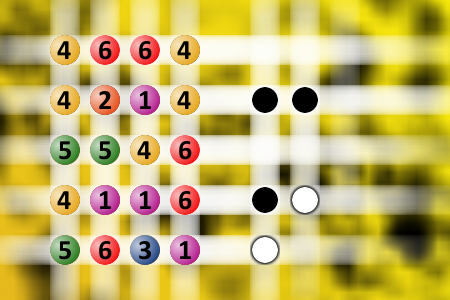
Which is a winning combination of digits?
[8430] Which is a winning combination of digits? - The computer chose a secret code (sequence of 4 digits from 1 to 6). Your goal is to find that code. Black circles indicate the number of hits on the right spot. White circles indicate the number of hits on the wrong spot. - #brainteasers #mastermind - Correct Answers: 7
BRAIN TEASERS
enter your answer and press button OK

Which is a winning combination of digits?

The computer chose a secret code (sequence of 4 digits from 1 to 6). Your goal is to find that code. Black circles indicate the number of hits on the right spot. White circles indicate the number of hits on the wrong spot.
Correct answers: 7
#brainteasers #mastermind
Register with your Google Account and start collecting points.
Check your ranking on list.

Three old men

Three old men are talking about their aches, pains and bodily dysfunctions.

One 75-year-old man says: "I have this problem. I wake up every morning at 7 a.m. and it takes me 20 minutes to pee."

An 80-year-old man says: "My case is worse. I get up at 8 a.m. and I sit there and grunt and groan for half an hour before I finally have a bowel movement."

The 90-year-old man says: "Not me. At 7 a.m. I pee like a horse and at 8 a.m. I crap like a cow."

"So what's your problem?" asked the others.

"I don't wake up until 9:00."

Jokes of the day - Daily updated jokes. New jokes every day.
Follow Brain Teasers on social networks

Brain Teasers

puzzles, riddles, mathematical problems, mastermind, cinemania...

Sir John C. Eccles

Died 2 May 1997 at age 94 (born 27 Jan 1903). John Carew Eccles was an Australian physiologist who shared, (with Alan Hodgkin and Andrew Huxley) the 1963 Nobel Prize for Physiology or Medicine for his discovery of the chemical means by which impulses are communicated or repressed by nerve cells. He also showed how signals pass between nerves and muscles. A nerve cell that is switched on by receiving a signal passes a chemical on to the next cell in line. This chemical expands minute openings in cell membranes, allowing ions to flood inside, reversing the electrical charge of the cell. This activity is repeated along the chain of cells, permitting transmission of the original impulse through the body. Eccles observed living cells in action by planting exceptionally tiny electrodes in them.
This site uses cookies to store information on your computer. Some are essential to help the site properly. Others give us insight into how the site is used and help us to optimize the user experience. See our privacy policy.