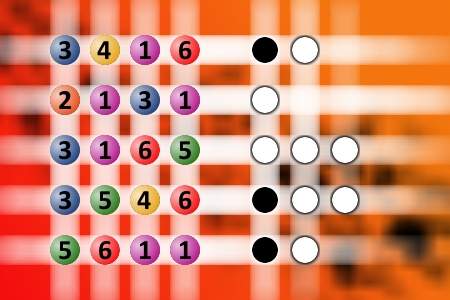
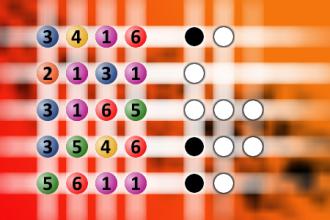
Which is a winning combination of digits?
[8440] Which is a winning combination of digits? - The computer chose a secret code (sequence of 4 digits from 1 to 6). Your goal is to find that code. Black circles indicate the number of hits on the right spot. White circles indicate the number of hits on the wrong spot. - #brainteasers #mastermind - Correct Answers: 1
BRAIN TEASERS
enter your answer and press button OK

Which is a winning combination of digits?

The computer chose a secret code (sequence of 4 digits from 1 to 6). Your goal is to find that code. Black circles indicate the number of hits on the right spot. White circles indicate the number of hits on the wrong spot.
Correct answers: 1
#brainteasers #mastermind
Register with your Google Account and start collecting points.
Check your ranking on list.

Great Toast

John O'Reilly hoisted his beer and said, "Here's to spending the rest of me life between the legs of me wife!" That won him the top prize for the best toast of the night.
He went home and told his wife, Mary, "I won the prize for the best toast of the night." She said, "Aye, John, what was your toast?" John Said, "Here's to spending the rest of me life sitting in church beside me wife." "Oh, that is very nice indeed, John," Mary said.
The next day, Mary ran into one of John's toasting buddies on the street corner. The man chuckled leeringly and said, "John won the prize, the other night, with a toast about you, Mary."
She said, "Aye and I was a bit surprised myself! You know, he's only been there twice. Once he fell asleep, and the other time I had to pull him by the ears to make him come".

Jokes of the day - Daily updated jokes. New jokes every day.
Follow Brain Teasers on social networks

Brain Teasers

puzzles, riddles, mathematical problems, mastermind, cinemania...

Steven Chu

Born 28 Feb 1948. American physicist who (with Claude Cohen-Tannoudji and William D. Phillips) was awarded the 1997 Nobel Prize for Physics for their independent, pioneering research in cooling and trapping atoms using laser light. In their normal state the constant random thermal motion of atoms limits precise measurements of atomic states. Thus, physicists sought to cool and slow atoms down as much as possible. Chu used six laser beams and worked with a hot gas of sodium atoms. He managed to cool and trap atoms in what he called “optical molasses.” By 1985, he had cooled sodium atoms to a temperature of about 240 millionth of a degree above absolute zero. The atoms could be trapped in the laser beams for a period of about half a second. He was chosen by President Obama to become the 12th U.S. Secretary of Energy (2009-2013).
This site uses cookies to store information on your computer. Some are essential to help the site properly. Others give us insight into how the site is used and help us to optimize the user experience. See our privacy policy.