You do not want to have me, Bu...
[1884] You do not want to have me, Bu... - You do not want to have me, But when you have me, You do not want to lose me. What am I? - #brainteasers #riddles - Correct Answers: 56 - The first user who solved this task is Sanja Šabović
BRAIN TEASERS
enter your answer and press button OK

You do not want to have me, Bu...

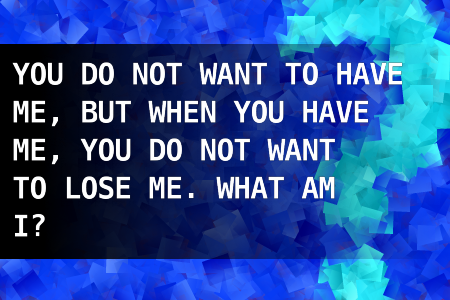
You do not want to have me, But when you have me, You do not want to lose me. What am I?
Correct answers: 56
The first user who solved this task is Sanja Šabović.
#brainteasers #riddles
Register with your Google Account and start collecting points.
Check your ranking on list.

There was this Asian lady marr...

There was this Asian lady married to an English gentleman and they lived in London. The poor lady was not very proficient in English, but managed to communicate with her husband. The real problem arose whenever she had to shop for groceries.
One day, she went to the butcher and wanted to buy pork legs. She didn't know how to put forward her request, and in esperation, lifted up her skirt to show her thighs. The butcher got the message and the lady went home with pork legs.
The next day, she needed to get chicken breasts. Again, she didn't know how to say, and so she unbuttoned her blouse to show the butcher her breast.
The lady got what she wanted.
The 3rd day, the poor lady needed to buy sausages. Unable to find a way to communicate this, she brought her husband to the store...
What were you thinking? Hellooo, her husband speaks English!!
Jokes of the day - Daily updated jokes. New jokes every day.
Follow Brain Teasers on social networks

Brain Teasers

puzzles, riddles, mathematical problems, mastermind, cinemania...

J.C. Arthur

Born 11 Jan 1850; died 30 Apr 1942 at age 92.Joseph Charles Arthur was an American botanist who discovered basic facts about the parasitic fungi known as 'rusts.' He was the first head of the Department of Botany and Plant Pathology at Purdue University. The plant rusts form one of the largest natural groups of plant parasitic fungi. They are of great scientific interest because of their close evolutionary relationships with their host plants, their complex life cycles, and their numerous biological adaptations that permit them to thrive on all the continents (except Antarctica) under great extremes of environments.
This site uses cookies to store information on your computer. Some are essential to help the site properly. Others give us insight into how the site is used and help us to optimize the user experience. See our privacy policy.