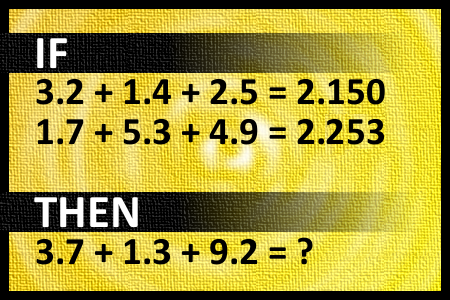
Calculate 3.7 + 1.3 + 9.2
[175] Calculate 3.7 + 1.3 + 9.2 - FUNNY MATH: Calculate 3.7 + 1.3 + 9.2 :) - #brainteasers #math - Correct Answers: 18 - The first user who solved this task is Sanja Šabović
BRAIN TEASERS
enter your answer and press button OK

Calculate 3.7 + 1.3 + 9.2

FUNNY MATH: Calculate 3.7 + 1.3 + 9.2 :)
Correct answers: 18
The first user who solved this task is Sanja Šabović.
#brainteasers #math
Register with your Google Account and start collecting points.
Check your ranking on list.

Teenage Daughters

There's an Englishman, Irishman & Scotsman all talking about their teenage daughters...

The Englishman says " I was cleaning my daughter's room the other day & I found a packet of cigarettes. I was really shocked as I didn't even know she smokes".

The Scotsman says " That's nothing. I was cleaning my daughter's room the other day when I came across a half full bottle of Vodka. I was really shocked as I didn't even know she drank."

With that the Irishman says " Both of you have got nothing to worry about. I was cleaning my daughter's room the other day when I found packet of condoms. I was really shocked. I didn't even know she had a cock."

Jokes of the day - Daily updated jokes. New jokes every day.
Follow Brain Teasers on social networks

Brain Teasers

puzzles, riddles, mathematical problems, mastermind, cinemania...

Sir Joseph Wilson Swan

Died 27 May 1914 at age 85 (born 31 Oct 1828). English scientist, chemist, physicist and inventor, born in Sunderland, Yorkshire, who produced an early electric incandescent lamp. He began these experiments in the 1840's and obtained a UK patent covering a partial vacuum, carbon filament incandescent lamp in 1860. Swan's early lamps provided low light output, were short lived, and were operated from battery cells. Low voltage operation required relatively high filament current that necessitated that the power source be co-located near the Swan lamp. He also addressed the problem of photographic print fading and in the mid 1850s some began to experiment with a solution using carbon, perfecting and patenting the process in 1864. Thus Swan invented the dry photographic plate, an important improvement in photography.[Image: pencil drawing by M. Agnes Cohen, 1894.]
This site uses cookies to store information on your computer. Some are essential to help the site properly. Others give us insight into how the site is used and help us to optimize the user experience. See our privacy policy.