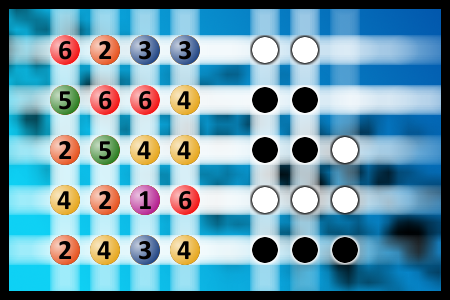
Find the right combination
[172] Find the right combination - The computer chose a secret code (sequence of 4 digits from 1 to 6). Your goal is to find that code. Black circles indicate the number of hits on the right spot. White circles indicate the number of hits on the wrong spot. - #brainteasers #mastermind - Correct Answers: 83 - The first user who solved this task is Jasmina Atarac-Pantelic
BRAIN TEASERS
enter your answer and press button OK

Find the right combination

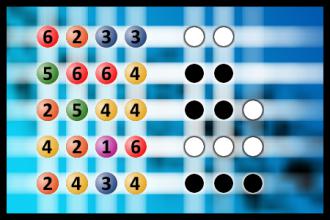
The computer chose a secret code (sequence of 4 digits from 1 to 6). Your goal is to find that code. Black circles indicate the number of hits on the right spot. White circles indicate the number of hits on the wrong spot.
Correct answers: 83
The first user who solved this task is Jasmina Atarac-Pantelic.
#brainteasers #mastermind
Register with your Google Account and start collecting points.
Check your ranking on list.

A husband is advised by a psyc...

A husband is advised by a psychiatrist to assert himself. "You don't have to let your wife henpeck you! Go home and show her you are the boss!"

Of course, the husband takes the doctor's advice. He rushes home, slams the door, shakes his fist in his wife's face, and growls, "From now on, you're taking orders from me! I want my supper right now and when you get it on the table, go upstairs and lay out my best clothes. Tonight, I'm going out with the boys and you are going to stay at home where you belong! And another thing... guess who's going to comb my hair, give me a shave, and tie my necktie?"

His redheaded wife says calmly, "The undertaker."
Jokes of the day - Daily updated jokes. New jokes every day.
Follow Brain Teasers on social networks

Brain Teasers

puzzles, riddles, mathematical problems, mastermind, cinemania...

Baron Edgar Douglas Adrian

Died 4 Aug 1977 at age 87 (born 30 Nov 1889). English electrophysiologist who is one of the founders of modern neurophysiology. He shared (with Sir Charles Sherrington) the Nobel Prize for Physiology or Medicine in 1932 for “for their discoveries regarding the functions of neurons.”While a student under Keith Lucas at Cambridge, Adrian discovered the “all-or-none”phenomenon (the relation between stimulus intensity and muscle-fibre contraction) in muscle-nerve preparations. During a career at Cambridge he developed the capillary electrometer to measure minute signals from nerve fibres and discovered the nature of coding of the motor and sensory impulses in afferent and efferent fibres. In the early 1930s, he advanced concepts of electro-encephalography, research on electrical brain waves.
This site uses cookies to store information on your computer. Some are essential to help the site properly. Others give us insight into how the site is used and help us to optimize the user experience. See our privacy policy.