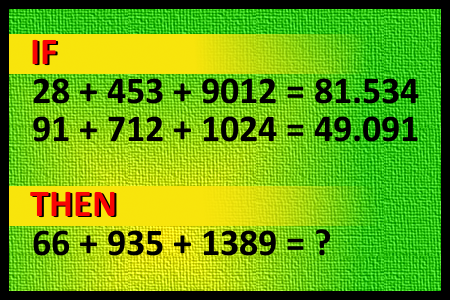
Calculate 66+935+1389
[367] Calculate 66+935+1389 - FUNNY MATH: Calculate 66+935+1389 - #brainteasers #math - Correct Answers: 26 - The first user who solved this task is Sanja Šabović
BRAIN TEASERS
enter your answer and press button OK

Calculate 66+935+1389

FUNNY MATH: Calculate 66+935+1389
Correct answers: 26
The first user who solved this task is Sanja Šabović.
#brainteasers #math
Register with your Google Account and start collecting points.
Check your ranking on list.

The passengers were leaving th...

The passengers were leaving the plane after landing, and one smiling, satisfied passenger paused to congratulate the flight attendant.
"Stewardess," he said happily, "I want to compliment you and the crew and especially the captain for getting here right on time. It's not often that an airline gets to where it's going exactly when they claim it will. I'm going to call your home office and let them know how pleased I am."
"Why, thank you, sir," the flight attendant answered, "but I think you should know something ... this is yesterday's flight."
Jokes of the day - Daily updated jokes. New jokes every day.
Follow Brain Teasers on social networks

Brain Teasers

puzzles, riddles, mathematical problems, mastermind, cinemania...

Carl Gassner

Died 31 Jan 1942 at age 86 (born 17 Nov 1855).German physician and inventor who was an eyes and ears specialist, but is best known for inventing the first dry cell battery (1886). It used the same principle as the Leclanché cell. A carbon manganese rod was the anode. Instead of a liquid electrolyte, he devised a porous paste form with sal ammoniac, plaster, zinc chloride and water. All were sealed in a a zinc can that also was the cathode. Lechanché cells had been used for electric door bells, but those were vulnerable to breakage and spillage, as well as needing fresh water added periodically. To help a store-keeper, Gessner devised his dry cell as an better alternative.He obtained a German patent (8 Apr 1886), a British provisional patent (No. 18,754 on 22 Dec 1888), and a U.S. patent (No. 373,064 on 15 Nov 1887) as well as patents in Austria-Hungary, Belgium and France.«
This site uses cookies to store information on your computer. Some are essential to help the site properly. Others give us insight into how the site is used and help us to optimize the user experience. See our privacy policy.