Find the right combination
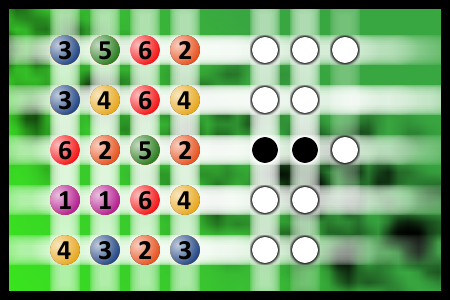
[1590] Find the right combination - The computer chose a secret code (sequence of 4 digits from 1 to 6). Your goal is to find that code. Black circles indicate the number of hits on the right spot. White circles indicate the number of hits on the wrong spot. - #brainteasers #mastermind - Correct Answers: 55 - The first user who solved this task is James Lillard
BRAIN TEASERS
enter your answer and press button OK

Find the right combination

The computer chose a secret code (sequence of 4 digits from 1 to 6). Your goal is to find that code. Black circles indicate the number of hits on the right spot. White circles indicate the number of hits on the wrong spot.
Correct answers: 55
The first user who solved this task is James Lillard.
#brainteasers #mastermind
Register with your Google Account and start collecting points.
Check your ranking on list.

Some short Labor Day Jokes

First Monday in September is Labor Day, enjoy Monday Off.

I had a joke about Labor Day...
unfortunately it didn’t work out

Did you hear the joke about Labor Day?
It really doesn’t work for me.

What’s a laborer’s favorite exercise?
“Work-outs!”

Have some jokes during 3 day weekend and check out some older Older Labor day jokes Read more on page:

Why do locksmiths work on Labor Day?
Because they are key workers.

Why is it cheap to have zombie employees?
Because they don’t need a living wage.

What did the employee say at the end of the long weekend?
I guess it’s back to the grind!

What do you usually do on Labour Day?
As little as possible, just like every day!

Jokes of the day - Daily updated jokes. New jokes every day.
Follow Brain Teasers on social networks

Brain Teasers

puzzles, riddles, mathematical problems, mastermind, cinemania...

Karl Dussik

Died 19 Mar 1968 at age 60 (born 9 Jan 1908).Karl (Theodore) Dussik was an Austrian neurologist and psychiatrist who has been called the "Father of Ultrasonic Diagnosis". In 1942, he published the first transmission ultrasound investigation of the brain Hyperphonography of the Brain, which he used to image a cerebral ventrical. He placing a patient's head between an ultrasound emitter and a receiver. In this way, he tried to visualize the cerebral ventricles by measuring the ultrasound beam modification through the head. However, the bone of the skull absorbed much of the ultrasound energy, and the image created by different bone thickness obscured any reliable image of the brain alone. However, his work with transmitted ultrasound stimulated the use of reflection techniques.«
This site uses cookies to store information on your computer. Some are essential to help the site properly. Others give us insight into how the site is used and help us to optimize the user experience. See our privacy policy.