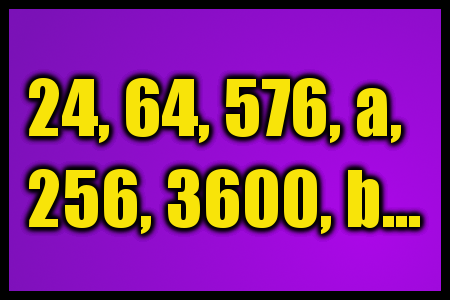
Calculate A+B
[734] Calculate A+B - Determine the pattern and calculate A+B. Author: Dejan Marsenic (Serbia) - #brainteasers #math - Correct Answers: 39 - The first user who solved this task is Sanja Šabović
BRAIN TEASERS
enter your answer and press button OK

Calculate A+B

Determine the pattern and calculate A+B. Author: Dejan Marsenic (Serbia)
Correct answers: 39
The first user who solved this task is Sanja Šabović.
#brainteasers #math
Register with your Google Account and start collecting points.
Check your ranking on list.

Doctor Doctor Collection 04

Doctor Doctor I feel like a racehorse.
Take one of these every 4 laps!

Doctor, doctor my sister here keeps thinking she's invisible!
What sister?

Doctor, Doctor I'm on a diet and it's making me irritable. Yesterday I bit someones ear off.
Oh dear, that's a lot of calories!

Doctor, Doctor Can I have second opinion?
Of course, come back tomorrow!
Doctor, Doctor you have to help me out!
Certainly, which way did you come in?

Doctor, Doctor I keep thinking I'm God
When did this start?
Well first I created the sun, then the earth...

Doctor, Doctor I keep thinking I'm invisible
Who said that?

Jokes of the day - Daily updated jokes. New jokes every day.
Follow Brain Teasers on social networks

Brain Teasers

puzzles, riddles, mathematical problems, mastermind, cinemania...

Cyril Stanley Smith

Born 4 Oct 1903; died 25 Aug 1952 at age 48.British-American metallurgist who in 1943-44 determined the properties and technology of plutonium and uranium, the essential materials in the atomic bombs that were first exploded in 1945. Smith already then had 15 years of experience as a research metallurgist with the American Brass Co., during which time he studied properties of alloys and their microstructure. In WW II, he joined the Los Alamos Laboratory at its inception (1943). The properties and technology of plutonium had to be conducted with extremely limited quantities of available material. Smith and his group found it was unique, with five different allotropic forms with huge density differences between them. Postwar, he organized the Institute for the Study of Metal at the Univ. of Chicago.
This site uses cookies to store information on your computer. Some are essential to help the site properly. Others give us insight into how the site is used and help us to optimize the user experience. See our privacy policy.