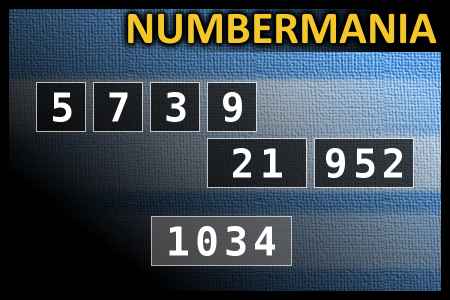
Calculate the number 1034
[870] Calculate the number 1034 - NUMBERMANIA: Calculate the number 1034 using numbers [5, 7, 3, 9, 21, 952] and basic arithmetic operations (+, -, *, /). Each of the numbers can be used only once. - #brainteasers #math #numbermania - Correct Answers: 29 - The first user who solved this task is Sanja Šabović
BRAIN TEASERS
enter your answer and press button OK

Calculate the number 1034

NUMBERMANIA: Calculate the number 1034 using numbers [5, 7, 3, 9, 21, 952] and basic arithmetic operations (+, -, *, /). Each of the numbers can be used only once.
Correct answers: 29
The first user who solved this task is Sanja Šabović.
#brainteasers #math #numbermania
Register with your Google Account and start collecting points.
Check your ranking on list.

12 Dad Jokes for National Tell A Joke Day

Monsters are not good at math.... Unless you Count Dracula.

19 had fight with 20 ... and 21

I would tell a joke about pzza, but its too cheesy

I gave away all my batteries today ... free of charge

I got a universal remote for Christmas ... well this changes everything

I had a joke about construction, but im still working on it

Did u get a haircut? No i cut them all out

Dracula doesnt have many friends because hese a pain in the neck.

I stayed up all night wondering where the Sun had gone. Then it dawned on me.

What did the sushi say to the bumble bee? Wasabi

Mountain aren't just funny, their hill areas.

I asked dad for his best dad joke, he said you.

Jokes of the day - Daily updated jokes. New jokes every day.
Follow Brain Teasers on social networks

Brain Teasers

puzzles, riddles, mathematical problems, mastermind, cinemania...

Quaternions

In 1843, the theory of quaternions was born when a sudden thought came to William Rowan Hamilton (1805-1865) as he was walking with his wife along the Royal Canal in Dublin, Ireland. (He had been working since the late 1830s on the basic principles of algebra, resulting in a theory of conjugate functions, or algebraic couples, in which complex numbers are expressed as ordered pairs of real numbers. Until now, he had not been successful in developing a theory of triplets that could be applied to three-dimensional geometric problems.) During the walk, he realized that the theory should involve quadruplets, not triplets. His excitement at his discovery caused him to pause and carve the underlying equations in a nearby bridge.
This site uses cookies to store information on your computer. Some are essential to help the site properly. Others give us insight into how the site is used and help us to optimize the user experience. See our privacy policy.