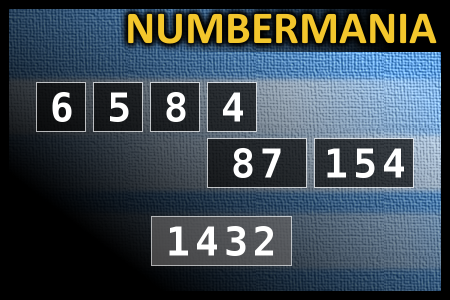
Calculate the number 1432
[1377] Calculate the number 1432 - NUMBERMANIA: Calculate the number 1432 using numbers [6, 5, 8, 4, 87, 154] and basic arithmetic operations (+, -, *, /). Each of the numbers can be used only once. - #brainteasers #math #numbermania - Correct Answers: 26 - The first user who solved this task is Sanja Šabović
BRAIN TEASERS
enter your answer and press button OK

Calculate the number 1432

NUMBERMANIA: Calculate the number 1432 using numbers [6, 5, 8, 4, 87, 154] and basic arithmetic operations (+, -, *, /). Each of the numbers can be used only once.
Correct answers: 26
The first user who solved this task is Sanja Šabović.
#brainteasers #math #numbermania
Register with your Google Account and start collecting points.
Check your ranking on list.

Passport

An old lady had always wanted to travel abroad. Now that she was getting on in years, she thought she would really like to do so before she died.

Until now, she'd never even been out of the country. So she began by going in person to the Passport Office and asking how long it would take to have one issued.

"You must take the loyalty oath first," responded the passport clerk. "Raise your right hand, please. "The old gal raised her right hand.

"Do you swear to defend the Constitution of the United States against all its enemies, domestic or foreign?" was the first question.

The little old lady's face paled and her voice trembled as she asked in a small voice, "Uhhh . . . all by myself?"

Jokes of the day - Daily updated jokes. New jokes every day.
Follow Brain Teasers on social networks

Brain Teasers

puzzles, riddles, mathematical problems, mastermind, cinemania...

Johann Salamo Christoph Schweigger

Born 8 Apr 1779; died 6 Sep 1857 at age 78.German physicist who invented the galvanometer (1820), a device to measure the strength of an electric current. He developed the principle from Oersted's experiment (1819) which showed that current in a wire will deflect a compass needle. Schweigger realized that suggested a basic measuring instrument, since a stronger current would produce a larger deflection, and he increased the effect by winding the wire many times in a coil around the magnetic needle. He named this instrument a “galvanometer”in honour of Luigi Galvani, the professor who gave Volta the idea for the first battery. Thomas Seebeck (1770-1831) named the innovative coil, Schweigger's multiplier. It became the basis of moving coil instruments and loudspeakers.
This site uses cookies to store information on your computer. Some are essential to help the site properly. Others give us insight into how the site is used and help us to optimize the user experience. See our privacy policy.