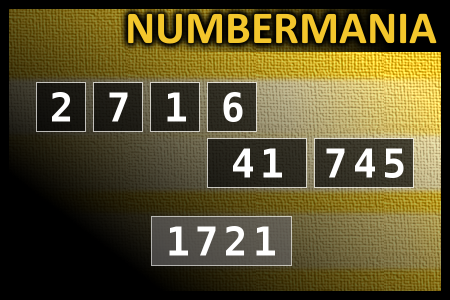
Calculate the number 1721
[834] Calculate the number 1721 - NUMBERMANIA: Calculate the number 1721 using numbers [2, 7, 1, 6, 41, 745] and basic arithmetic operations (+, -, *, /). Each of the numbers can be used only once. - #brainteasers #math #numbermania - Correct Answers: 28 - The first user who solved this task is Sanja Šabović
BRAIN TEASERS
enter your answer and press button OK

Calculate the number 1721

NUMBERMANIA: Calculate the number 1721 using numbers [2, 7, 1, 6, 41, 745] and basic arithmetic operations (+, -, *, /). Each of the numbers can be used only once.
Correct answers: 28
The first user who solved this task is Sanja Šabović.
#brainteasers #math #numbermania
Register with your Google Account and start collecting points.
Check your ranking on list.

Increase the donation

The crumbling, old church building needed remodeling, so the preacher made an impassioned appeal, looking directly at the richest may in town. At the end of the message, the rich man stood up and announced, "Pastor, I will contribute $1,000."

Just then, plaster fell from the ceiling and struck the rich man on the shoulder. He promptly stood again and shouted, "Pastor, I will increase my donation to $5,000."

Before he could sit back down, plaster fell on him again, and again he virtually screamed, "Pastor, I will double my last pledge."

He sat down, and an larger chunk of plaster fell hitting him on the head. He stood once more and hollered, "Pastor, I will give $20,000!"

This prompted a deacon to shout, "Hit him again, Lord! Hit him again!"

Jokes of the day - Daily updated jokes. New jokes every day.
Follow Brain Teasers on social networks

Brain Teasers

puzzles, riddles, mathematical problems, mastermind, cinemania...

Argand diagram

In 1797, the concept of a geometrical interpretation of complex numbers was submitted by Caspar Wessel in a paper to a meeting of the Royal Danish Academy of Sciences.He represented complex numbers as points in a Cartesian plane, with the real portion of the number on the x axis and the imaginary part on the y axis. This was also independently devised a few years later, by Jean-Robert Argand, an amateur mathematician who self-published his ideas in an anomymous monograph(1806). Through publicity generated when Argand came forward and identified himself as the author, it was his name that has the lasting association with the Argand diagram.«
This site uses cookies to store information on your computer. Some are essential to help the site properly. Others give us insight into how the site is used and help us to optimize the user experience. See our privacy policy.