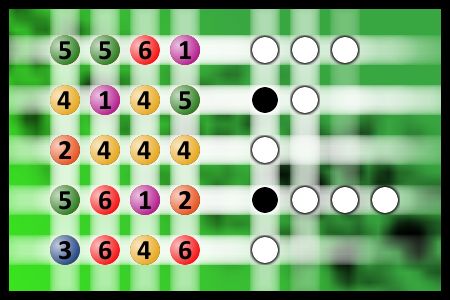
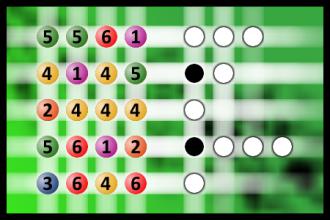
Which is a winning combination of digits?
[836] Which is a winning combination of digits? - The computer chose a secret code (sequence of 4 digits from 1 to 6). Your goal is to find that code. Black circles indicate the number of hits on the right spot. White circles indicate the number of hits on the wrong spot. - #brainteasers #mastermind - Correct Answers: 60 - The first user who solved this task is Sanja Šabović
BRAIN TEASERS
enter your answer and press button OK

Which is a winning combination of digits?

The computer chose a secret code (sequence of 4 digits from 1 to 6). Your goal is to find that code. Black circles indicate the number of hits on the right spot. White circles indicate the number of hits on the wrong spot.
Correct answers: 60
The first user who solved this task is Sanja Šabović.
#brainteasers #mastermind
Register with your Google Account and start collecting points.
Check your ranking on list.

A Texan was taking a taxi tour...

A Texan was taking a taxi tour of London and was in a hurry. As they went by the Tower of London the cab driver explained what it was and that construction of it started in 1346 and was completed in 1412.
The Texan replied, "Shoot, a little ol' tower like that? In Houston we'd have that thing up in two weeks!"
Next they passed the House of Parliament - started in 1544 and completed in 1618.
"Well boy, we put up a bigger one than that in Dallas and it only took a year!"
As they passed Westminster Abbey the cab driver was silent.
"Whoah! What's that over there?" asked the Texan.
The driver replied, "I don't know, it wasn't there yesterday."
Jokes of the day - Daily updated jokes. New jokes every day.
Follow Brain Teasers on social networks

Brain Teasers

puzzles, riddles, mathematical problems, mastermind, cinemania...

John Graunt

Born 24 Apr 1620; died 18 Apr 1674 at age 53. English statistician who is considered by many historians to have founded the science of demography (statistical study of human populations). For his published analysis of the parish records of christenings and deaths, he was made a charter member of the Royal Society. His 90-page book, “Natural and Political Observations Mentioned in a Following Index, and Made upon the Bills of Mortality” was distributed at the Royal Society meeting on 5 Feb 1662. He described his work as having “reduced several great confused volumes” of parish records into a few easily to understood tables, and “abridged such Observations... into a few succinct Paragraphs.” He initiated “life tables” of life expectancy. His use of demographics was further pioneered by his friend Sir William Petty and Edmond Halley, the Astronomer Royal.«
This site uses cookies to store information on your computer. Some are essential to help the site properly. Others give us insight into how the site is used and help us to optimize the user experience. See our privacy policy.