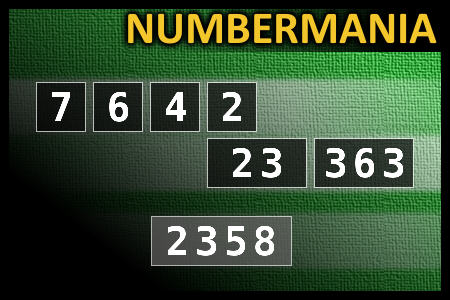
Calculate the number 2358
[426] Calculate the number 2358 - NUMBERMANIA: Calculate the number 2358 using numbers [7, 6, 4, 2, 23, 363] and basic arithmetic operations (+, -, *, /). Each of the numbers can be used only once. - #brainteasers #math #numbermania - Correct Answers: 34 - The first user who solved this task is Sanja Šabović
BRAIN TEASERS
enter your answer and press button OK

Calculate the number 2358

NUMBERMANIA: Calculate the number 2358 using numbers [7, 6, 4, 2, 23, 363] and basic arithmetic operations (+, -, *, /). Each of the numbers can be used only once.
Correct answers: 34
The first user who solved this task is Sanja Šabović.
#brainteasers #math #numbermania
Register with your Google Account and start collecting points.
Check your ranking on list.

Shane Mauss: Freak Accident

I went to a Six Flags. Theres this new ride there; I had to wait in line for, like, four hours to get on this thing. Finally got on it, it was fine enough. But then I see a couple of weeks later in the news, this girl goes on the exact same ride and, in some freak accident, her legs got lopped off at the knees. I was like, What a terrible thing to happen to all of those people waiting in line.
Jokes of the day - Daily updated jokes. New jokes every day.
Follow Brain Teasers on social networks

Brain Teasers

puzzles, riddles, mathematical problems, mastermind, cinemania...

Robert Rowe Gilruth

Died 17 Aug 2000 at age 86 (born 8 Oct 1913).American aerospace scientist, engineer, and a pioneer of the Mercury, Gemini, and Apollo space programs. He developed the X-1, first plane to break the sound barrier. Gilruth directed Project Mercury, the initial program for achieving manned space flight. Under his leadership, the first American astronaut orbited the Earth only a little over 3 years after NASA was created. In 1961, President Kennedy and the Congress committed the nation to a manned lunar landing within the decade. Gilruth was named the Director of the Manned Spacecraft Center and assigned the responsibility of designing and developing the spacecraft and associated equipment, planning and controlling missions, and training flight crews. He retired from NASA in 1973.
This site uses cookies to store information on your computer. Some are essential to help the site properly. Others give us insight into how the site is used and help us to optimize the user experience. See our privacy policy.