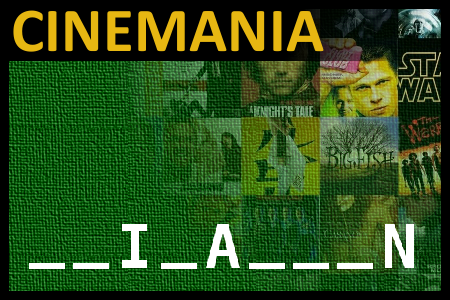
CINEMANIA: Guess the movie title
[422] CINEMANIA: Guess the movie title - A private detective hired to expose an adulterer finds himself caught up in a web of deceit, corruption and murder. Film was made in 1974. - #brainteasers #movie #film #cinemania - Correct Answers: 50 - The first user who solved this task is Eric Newton
BRAIN TEASERS
enter your answer and press button OK

CINEMANIA: Guess the movie title

A private detective hired to expose an adulterer finds himself caught up in a web of deceit, corruption and murder. Film was made in 1974.
Correct answers: 50
The first user who solved this task is Eric Newton.
#brainteasers #movie #film #cinemania
Register with your Google Account and start collecting points.
Check your ranking on list.

Harry under stress

Harry had been feeling sick lately and was finally convinced to see the Doctor after his wife Suzy's urging.
After a thorough examination, and much thought, the Doctor was ready to tell Harry and a very worried Suzy, his prognosis: Harry was too stressed out. He would need 6 months of pure relaxation.
Suzy, very agitated, took out her notepad to begin writing down his list of orders for these months of relaxation.
"How should I go about it?" asked Harry.
"OK," said the doctor, "I would like your wife to take one tranquilizer four times a day..."
Jokes of the day - Daily updated jokes. New jokes every day.
Follow Brain Teasers on social networks

Brain Teasers

puzzles, riddles, mathematical problems, mastermind, cinemania...

Kazimierz Ajdukiewicz

Died 12 Apr 1963 at age 72 (born 12 Dec 1890).Polish logician and semanticist who was the chief contributor to the Warsaw school of philosophy and logic, and is credited with developing in 1920 the first deductive theory for the study of logic based on syntax. The dominant theme of Ajdukiewicz's thought was the problem of the dependence of our knowledge and conception of knowledge on language. His main contributions are in the field of logical syntax (with the theory of semantical categories) and in epistemology, with the so-called “radical conventionalism,”a doctrine where he claimed that there exist conceptual apparatuses which are not intertranslatable and that scientific knowledge grows through the replacement of one such conceptual apparatus by another.
This site uses cookies to store information on your computer. Some are essential to help the site properly. Others give us insight into how the site is used and help us to optimize the user experience. See our privacy policy.