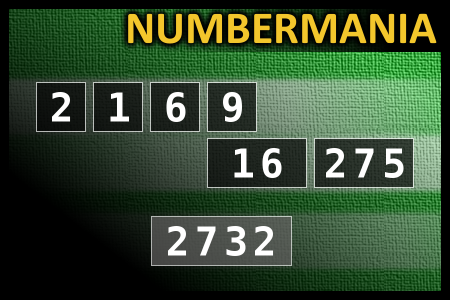
Calculate the number 2732
[574] Calculate the number 2732 - NUMBERMANIA: Calculate the number 2732 using numbers [2, 1, 6, 9, 16, 275] and basic arithmetic operations (+, -, *, /). Each of the numbers can be used only once. - #brainteasers #math #numbermania - Correct Answers: 38 - The first user who solved this task is Sanja Šabović
BRAIN TEASERS
enter your answer and press button OK

Calculate the number 2732

NUMBERMANIA: Calculate the number 2732 using numbers [2, 1, 6, 9, 16, 275] and basic arithmetic operations (+, -, *, /). Each of the numbers can be used only once.
Correct answers: 38
The first user who solved this task is Sanja Šabović.
#brainteasers #math #numbermania
Register with your Google Account and start collecting points.
Check your ranking on list.

Sister Mary Ann

Sister Mary Ann, who worked for a home health agency, was making her rounds. She was visiting homebound patients when she ran out of gas.
As luck would have it, a gas station was just a block away. She walked to the station to borrow a gas can and buy some gas. The attendant told her that the only gas can he owned had been loaned out, but she could wait until it was returned
Since Sister Mary Ann was on the way to see a patient, she decided not to wait and walked back to her car. She looked for something in her car that she could fill with gas and spotted the bedpan she was taking to the patient. Always resourceful, Sister Mary Ann carried the bedpan to the station, filled it with gasoline, and carried the full bedpan back to her car.
As she was pouring the gas into her tank, two Baptists watched from across the street. One of them turned to the other and said, "If it starts, I'm becoming Catholic."

Jokes of the day - Daily updated jokes. New jokes every day.
Follow Brain Teasers on social networks

Brain Teasers

puzzles, riddles, mathematical problems, mastermind, cinemania...

John Ray

Died 17 Jan 1705 at age 77 (born 29 Nov 1627). English naturalist and botanist who was a leader in his field during the 17th-century English and contributed significantly to progress in taxonomy, and is often referred to as the father of natural history in Britain. He toured Europe with Francis Willoughby in search of specimens of flora and fauna. Ray was the first to classify flowering plants into monocotyledons and dicotyledons. Ray established the species as the basic taxonomic unit - his enduring legacy to botany. His major work was the three-volume Historia Plantarum (1686-1704). He also attempted to classify the animal kingdom. In 1693 he published a system based on a number of structural characters, including internal anatomy, which provided a more natural classification than those being produced by his contemporaries.
This site uses cookies to store information on your computer. Some are essential to help the site properly. Others give us insight into how the site is used and help us to optimize the user experience. See our privacy policy.