What a winning combination?
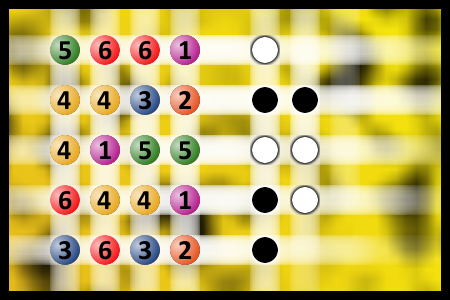
[569] What a winning combination? - The computer chose a secret code (sequence of 4 digits from 1 to 6). Your goal is to find that code. Black circles indicate the number of hits on the right spot. White circles indicate the number of hits on the wrong spot. - #brainteasers #mastermind - Correct Answers: 57 - The first user who solved this task is Sanja Šabović
BRAIN TEASERS
enter your answer and press button OK

What a winning combination?

The computer chose a secret code (sequence of 4 digits from 1 to 6). Your goal is to find that code. Black circles indicate the number of hits on the right spot. White circles indicate the number of hits on the wrong spot.
Correct answers: 57
The first user who solved this task is Sanja Šabović.
#brainteasers #mastermind
Register with your Google Account and start collecting points.
Check your ranking on list.

Indian Birth Names

This Indian boy goes to his mother one day with a puzzled look on his face.

"Say, mom, why is my bigger brother named "Mighty Storm"?

"Because he was conceived during a mighty storm."

"Why is my sister named "Cornflower"?

"Well, your father and I were in a cornfield, when we made her."

"And why is my other sister called "Moonchild"?

"We were watching the moon landing while she was conceived."

"Tell me, Torn Rubber, why are you so curious?"

Jokes of the day - Daily updated jokes. New jokes every day.
Follow Brain Teasers on social networks

Brain Teasers

puzzles, riddles, mathematical problems, mastermind, cinemania...

Hermann Boerhaave

Born 31 Dec 1668; died 23 Sep 1738 at age 69. Dutch physician, botanist and chemist, who as professor of medicine taught medical students at the sickbed. He has been called the “founder of clinical teaching” since he founded a hospital where he combined practice with clinical instruction, a method continued in modern medical education. He was the first to describe the sweat glands, and that smallpox is transmitted only by contact. Although his discoveries were few, he collated existing medical knowledge. He wrote medical textbooks popular both during and after his lifetime. In 1718, he became professor of chemistry, and published Elementa Chemiae (Elements of Chemistry, 1724), an intellegible work that eluciated the subject. He also made contributions in the field of botany. Sometimes called the “Dutch Hippocrates,” he was the most eminent physician since Galen.«
This site uses cookies to store information on your computer. Some are essential to help the site properly. Others give us insight into how the site is used and help us to optimize the user experience. See our privacy policy.