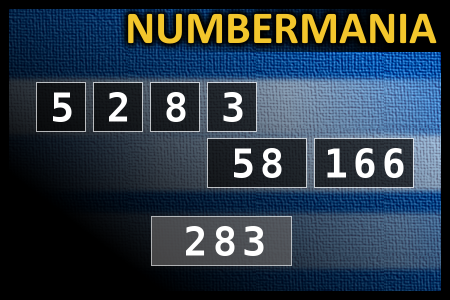
Calculate the number 283
[827] Calculate the number 283 - NUMBERMANIA: Calculate the number 283 using numbers [5, 2, 8, 3, 58, 166] and basic arithmetic operations (+, -, *, /). Each of the numbers can be used only once. - #brainteasers #math #numbermania - Correct Answers: 35 - The first user who solved this task is Sanja Šabović
BRAIN TEASERS
enter your answer and press button OK

Calculate the number 283

NUMBERMANIA: Calculate the number 283 using numbers [5, 2, 8, 3, 58, 166] and basic arithmetic operations (+, -, *, /). Each of the numbers can be used only once.
Correct answers: 35
The first user who solved this task is Sanja Šabović.
#brainteasers #math #numbermania
Register with your Google Account and start collecting points.
Check your ranking on list.

Seeing Eye Dog

A blind man is walking down the street with his seeing-eye dog. They come to a busy intersection and the dog, ignoring the high volume of traffic zooming by on the street, leads the blind man right out into thethick of the traffic. This is followed by the screech of tires and horns blaring as panicked drivers try desperately not to run the pair down.
The blind man and the dog finally reach the safety of the sidewalk on other side of the street and the blind man pulls a cookie out of his coat pocket which he offers to the dog.
A passerby, having observed the near fatal incident, can't control his amazement and says to the blind man, "Why on earth are you rewarding your dog with a cookie? He nearly got you killed!"
The blind man turns partially in his direction and replies, "To find out where his head is, so I can kick his ass."    

Jokes of the day - Daily updated jokes. New jokes every day.
Follow Brain Teasers on social networks

Brain Teasers

puzzles, riddles, mathematical problems, mastermind, cinemania...

Mikhail Semyonovich Tswett

Died 26 Jun 1919 at age 47 (born 14 May 1872).Russian botanist, the “father of chromatography,” who developed and named the adsorption chromatography technique of separating plant pigments by extracting them from leaves with ether and alcohol and percolating the solution through a column of calcium carbonate. The components of the mixture moved at different rates, producing a series of bands. He is known in particular for his study of the chlorophylls and the carotenoids. However, in Tswett's own lifetime, chromatography remained virtually unrecognized as a scientific tool. In the 1930s, it was rediscovered and then spread worldwide. The chromatography technique he invented is now widely used to separate substances from mixtures. (Also spelled Tsvet.)
This site uses cookies to store information on your computer. Some are essential to help the site properly. Others give us insight into how the site is used and help us to optimize the user experience. See our privacy policy.