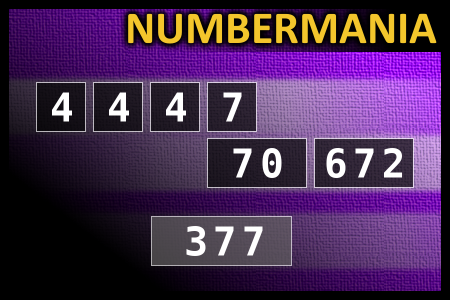
Calculate the number 377
[1502] Calculate the number 377 - NUMBERMANIA: Calculate the number 377 using numbers [4, 4, 4, 7, 70, 672] and basic arithmetic operations (+, -, *, /). Each of the numbers can be used only once. - #brainteasers #math #numbermania - Correct Answers: 33 - The first user who solved this task is Sanja Šabović
BRAIN TEASERS
enter your answer and press button OK

Calculate the number 377

NUMBERMANIA: Calculate the number 377 using numbers [4, 4, 4, 7, 70, 672] and basic arithmetic operations (+, -, *, /). Each of the numbers can be used only once.
Correct answers: 33
The first user who solved this task is Sanja Šabović.
#brainteasers #math #numbermania
Register with your Google Account and start collecting points.
Check your ranking on list.

How long...?

When the surgeon came to see Rita on the day after her operation, she asked him somewhat hesitantly just how long it would be before she could resume her sex life.

"Uh, I hadn't really thought about it" replied the stunned surgeon.

"You're the first one ever to ask that after a nose job...."

Jokes of the day - Daily updated jokes. New jokes every day.
Follow Brain Teasers on social networks

Brain Teasers

puzzles, riddles, mathematical problems, mastermind, cinemania...

Chewing gum patented

In 1869, William Finley Semple of Mount Vernon, Ohio, was issued the first U.S. patent for chewing gum (No. 98,304), made of "the combination of rubber with other articles adapted to the formation of an acceptable chewing gum", but he never commercially produced gum. That was done by Thomas Adams of Staten Island, N.Y., who knew that chicle could be chewed. His first experiments to vulcanize chicle for use as a rubber substitute were unsuccessful until he boiled a small batch of chicle in his kitchen and created the first chicle-based chewing gum. Testing sales at a local store, he found people liked his gum. In 1871, Adams patented a gum-producing machine so he could increase production.
This site uses cookies to store information on your computer. Some are essential to help the site properly. Others give us insight into how the site is used and help us to optimize the user experience. See our privacy policy.