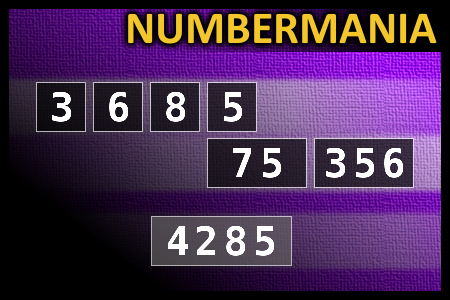
Calculate the number 4285
[360] Calculate the number 4285 - NUMBERMANIA: Calculate the number 4285 using numbers [3, 6, 8, 5, 75, 356] and basic arithmetic operations (+, -, *, /). Each of the numbers can be used only once. - #brainteasers #math #numbermania - Correct Answers: 26 - The first user who solved this task is Sanja Šabović
BRAIN TEASERS
enter your answer and press button OK

Calculate the number 4285

NUMBERMANIA: Calculate the number 4285 using numbers [3, 6, 8, 5, 75, 356] and basic arithmetic operations (+, -, *, /). Each of the numbers can be used only once.
Correct answers: 26
The first user who solved this task is Sanja Šabović.
#brainteasers #math #numbermania
Register with your Google Account and start collecting points.
Check your ranking on list.

Out of Eden

A Sunday school teacher asked her students to draw a picture of their favorite Old Testament story. As she moved around the class, she saw there were many wonderful drawings being done. Then she came across the drawing of one little boy. He was busy drawing a man driving an old car. In the backseat were two passengers—both scantily dressed.”"It's a lovely picture,” prompted the teacher, “but which story does it tell?”The little boy seemed surprised at the question. “Well,” he exclaimed, “doesn't it say in the Bible that God drove Adam and Eve out of the Garden of Eden?”
Jokes of the day - Daily updated jokes. New jokes every day.
Follow Brain Teasers on social networks

Brain Teasers

puzzles, riddles, mathematical problems, mastermind, cinemania...

Oskar Bolza

Born 12 May 1857; died 5 Jul 1942 at age 85.German mathematician who moved to the U.S. in 1888. He published The elliptic s-functions considered as a special case of the hyperelliptic s-functions in 1900. From 1910, he worked on the calculus of variations. Bolza wrote a classic textbook on the subject, Lectures on the Calculus of Variations (1904). He returned to Germany in 1910, where he researched function theory, integral equations and the calculus of variations. In 1913, he published a paper presenting a new type of variational problem now called "the problem of Bolza." The next year, he wrote about variations for an integral problem involving inequalities, which later become important in control theory. Bolza ceased his mathematical research work at the outbreak of WW I in 1914.«
This site uses cookies to store information on your computer. Some are essential to help the site properly. Others give us insight into how the site is used and help us to optimize the user experience. See our privacy policy.