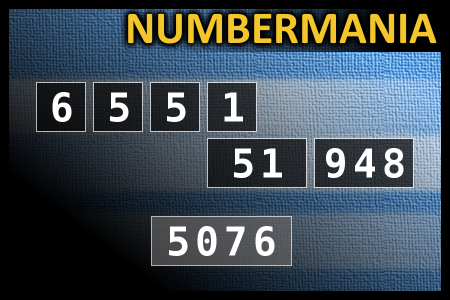
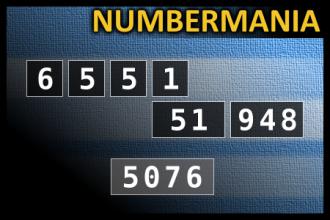
Calculate the number 5076
[1602] Calculate the number 5076 - NUMBERMANIA: Calculate the number 5076 using numbers [6, 5, 5, 1, 51, 948] and basic arithmetic operations (+, -, *, /). Each of the numbers can be used only once. - #brainteasers #math #numbermania - Correct Answers: 28 - The first user who solved this task is Sanja Šabović
BRAIN TEASERS
enter your answer and press button OK

Calculate the number 5076

NUMBERMANIA: Calculate the number 5076 using numbers [6, 5, 5, 1, 51, 948] and basic arithmetic operations (+, -, *, /). Each of the numbers can be used only once.
Correct answers: 28
The first user who solved this task is Sanja Šabović.
#brainteasers #math #numbermania
Register with your Google Account and start collecting points.
Check your ranking on list.

A wife comes home late at nigh...

A wife comes home late at night from being out of town and quietly opens the door to her bedroom.
From under the blanket she sees four legs instead of two. She reaches for a baseball bat and starts hitting the blanket as hard as she can. Once she's done, she goes to the kitchen to have a drink.
As she enters, she sees her husband there, reading a magazine.
"Hi Darling", he says, "Your parents have come to visit us, so l let them stay in our bedroom. Did you say 'hello'?"
Jokes of the day - Daily updated jokes. New jokes every day.
Follow Brain Teasers on social networks

Brain Teasers

puzzles, riddles, mathematical problems, mastermind, cinemania...

Walter S. Sutton

Born 5 Apr 1877; died 10 Nov 1916 at age 39. Walter Stanborough Sutton was an American geneticist who provided the first conclusive evidence that chromosomes carry the units of inheritance and occur in distinct pairs. While he was working as a graduate student at Columbia University, studying grasshopper cells, Sutton observed that chromosomes occurred in distinct pairs, and that during meiosis, the chromosome pairs split, and each chromosome goes to its own cell. Sutton announced this discovery in his 1902 paper On the Morphology of the Chromosome Group in Brachyotola. In 1903, Sutton discovered that chromosomes contained genes, and that their behavior during meiosis was random, concepts that later provided the basis for the Chromosomal Theory of Heredity.
This site uses cookies to store information on your computer. Some are essential to help the site properly. Others give us insight into how the site is used and help us to optimize the user experience. See our privacy policy.