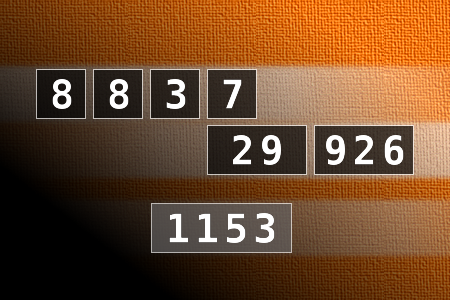

Calculate the number 1153
[5380] Calculate the number 1153 - NUMBERMANIA: Calculate the number 1153 using numbers [8, 8, 3, 7, 29, 926] and basic arithmetic operations (+, -, *, /). Each of the numbers can be used only once. - #brainteasers #math #numbermania - Correct Answers: 23 - The first user who solved this task is Djordje Timotijevic
BRAIN TEASERS
enter your answer and press button OK

Calculate the number 1153

NUMBERMANIA: Calculate the number 1153 using numbers [8, 8, 3, 7, 29, 926] and basic arithmetic operations (+, -, *, /). Each of the numbers can be used only once.
Correct answers: 23
The first user who solved this task is Djordje Timotijevic.
#brainteasers #math #numbermania
Register with your Google Account and start collecting points.
Check your ranking on list.

Question And Answer

Q: Did you hear about the Irishman who was tap dancing?
A: He broke his ankle when he fell into the sink.
Q: What's Irish and sits outside in the summertime?
A: Paddy O'Furniture!
Q: What are the best ten years of an Irishman's life?
A: Third grade.
Q: How do you sink an Irish submarine?
A: Knock on the hatch.
Q: How can you identify an Irish pirate?
A: He's the one with patches over both eyes.
Jokes of the day - Daily updated jokes. New jokes every day.
Follow Brain Teasers on social networks

Brain Teasers

puzzles, riddles, mathematical problems, mastermind, cinemania...

Nikolai Przhevalsky

Born 31 Mar 1839; died 20 Oct 1888 at age 49.Russian explorer who discovered a wild camel and a primitive horse (named Przhevalsky's horse), during expeditions in the mountain regions between Tibet and Mongolia, collecting both plants and animals. In 1881, Przewalski made an official statement describing the horse: its appearance, characteristics and remote habitat. They lived in herds of 5 to 15 animals led by a stallion. He noted that they were alert and very shy, with acute hearing, very good eyesight and a highly developed sense of smell. They seemed to prefer saline soils and could survive for a long time without water. On his fifth expedition, while investigating Lake Issyk Kul's shores, he died after drinking typhoid-infected water. By 1969, the species was thought extinct in the wild. By breeding the few surviving in zoos, some have been reintroduced to the wild.«
This site uses cookies to store information on your computer. Some are essential to help the site properly. Others give us insight into how the site is used and help us to optimize the user experience. See our privacy policy.