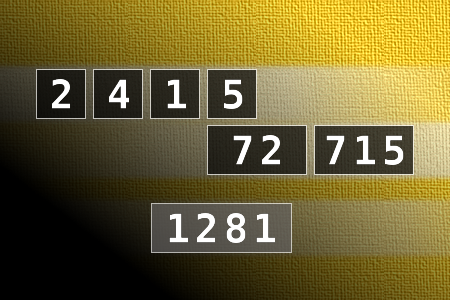
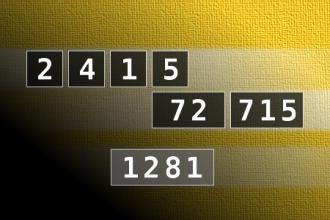
Calculate the number 1281
[4666] Calculate the number 1281 - NUMBERMANIA: Calculate the number 1281 using numbers [2, 4, 1, 5, 72, 715] and basic arithmetic operations (+, -, *, /). Each of the numbers can be used only once. - #brainteasers #math #numbermania - Correct Answers: 18 - The first user who solved this task is Djordje Timotijevic
BRAIN TEASERS
enter your answer and press button OK

Calculate the number 1281

NUMBERMANIA: Calculate the number 1281 using numbers [2, 4, 1, 5, 72, 715] and basic arithmetic operations (+, -, *, /). Each of the numbers can be used only once.
Correct answers: 18
The first user who solved this task is Djordje Timotijevic.
#brainteasers #math #numbermania
Register with your Google Account and start collecting points.
Check your ranking on list.

Three Eggs and $100

An elderly pastor was searching his closet for his collar before church one Sunday morning. In the back of the closet, he found a small box containing three eggs and 100 $1 bills. He called his wife into the closet to ask her about the box and its contents. Embarrassed, she admitted having hidden the box there for their entire 30 years of marriage. Disappointed and hurt, the pastor asked her, "Why?" The wife replied that she hadn't wanted to hurt his feelings. He asked her how the box could have hurt his feelings. She said that every time during their marriage that he had delivered a poor sermon, she had placed an egg in the box. The pastor felt that three poor sermons in 30 years was certainly nothing to feel bad about, so he asked her what the $100 was for. She replied, "Each time I got a dozen eggs, I sold them to the neighbors for $1."
Jokes of the day - Daily updated jokes. New jokes every day.
Follow Brain Teasers on social networks

Brain Teasers

puzzles, riddles, mathematical problems, mastermind, cinemania...

Sir Aaron Klug

Born 11 Aug 1926. British biochemist who received the 1982 Nobel Prize for Chemistry "for his development of crystallographic electron microscopy and his structural elucidation of biologically important nucleic acid-protein complexes." Whereas X-ray diffraction patterns reveal any highly ordered three-dimensional crystalline structures, the technique fails for those biological samples with less suitably ordered molecular structures. However Klug developed crystallographic electron microscopy which combined certain principles of the diffraction methods with electron miscroscopy so that he could figure out the 3-D structure of viruses or samples of complicated combinations of nucleic acids and proteins as found in membranes, muscle fibres and chromosomes.«
This site uses cookies to store information on your computer. Some are essential to help the site properly. Others give us insight into how the site is used and help us to optimize the user experience. See our privacy policy.