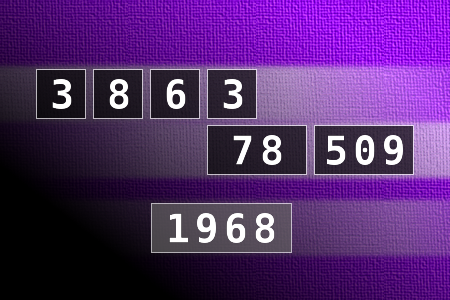
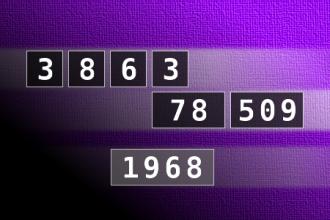
Calculate the number 1968
[5093] Calculate the number 1968 - NUMBERMANIA: Calculate the number 1968 using numbers [3, 8, 6, 3, 78, 509] and basic arithmetic operations (+, -, *, /). Each of the numbers can be used only once. - #brainteasers #math #numbermania - Correct Answers: 16 - The first user who solved this task is Djordje Timotijevic
BRAIN TEASERS
enter your answer and press button OK

Calculate the number 1968

NUMBERMANIA: Calculate the number 1968 using numbers [3, 8, 6, 3, 78, 509] and basic arithmetic operations (+, -, *, /). Each of the numbers can be used only once.
Correct answers: 16
The first user who solved this task is Djordje Timotijevic.
#brainteasers #math #numbermania
Register with your Google Account and start collecting points.
Check your ranking on list.

A professor of chemistry wante...

A professor of chemistry wanted to teach his 5th grade class a lesson about the evils of alcohol, so he produced an experiment that involved a glass of water, a glass of whiskey and two worms."Now, class. Observe closely the worms," said the professor putting a worm first into the water. The worm in the water writhed about, happy as a worm in water could be.
The second worm, he put into the whiskey. It writhed painfully, and quickly sank to the bottom, dead as a doornail.
"Now, what lesson can we derive from this experiment?" the professor asked.
Little Johnny, who naturally sits in back, raised his hand and wisely, responded...
"Drink whiskey and you won't get worms!"
Jokes of the day - Daily updated jokes. New jokes every day.
Follow Brain Teasers on social networks

Brain Teasers

puzzles, riddles, mathematical problems, mastermind, cinemania...

Merle Antony Tuve

Born 27 Jun 1901; died 20 May 1982 at age 80.American research physicist and geophysicist who (with Gregory Breit) made the first use pulsed radio waves to explore the ionosphere. He devised the necessary detecting equipment to measure the time between receiving a direct radio pulse and a second pulse reflected from the ionosphere. The observations he made provided the theoretical foundation for the development of radar. Tuve, with Lawrence R. Hafstad and Norman P. Heydenburg, made the first and definitive measurements of the nuclear force between proton-proton force at nuclear distances. During WW II he developed the proximity fuse. Following the war, he made important contributions to experimental seismology, radio astronomy, and optical astronomy.«
This site uses cookies to store information on your computer. Some are essential to help the site properly. Others give us insight into how the site is used and help us to optimize the user experience. See our privacy policy.