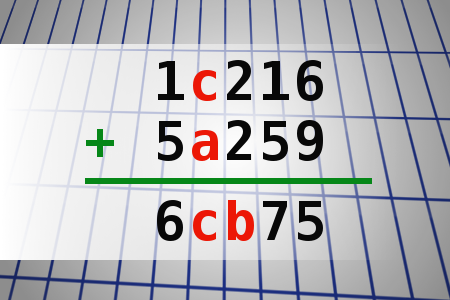
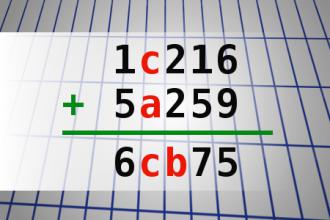
Find number abc
[5092] Find number abc - If 1c216 + 5a259 = 6cb75 find number abc. Multiple solutions may exist. - #brainteasers #math - Correct Answers: 57 - The first user who solved this task is Djordje Timotijevic
BRAIN TEASERS
enter your answer and press button OK

Find number abc

If 1c216 + 5a259 = 6cb75 find number abc. Multiple solutions may exist.
Correct answers: 57
The first user who solved this task is Djordje Timotijevic.
#brainteasers #math
Register with your Google Account and start collecting points.
Check your ranking on list.

The teenage granddaughter come...

The teenage granddaughter comes downstairs for her date with this see-through blouse on and no bra. Her grandmother just pitched a fit, telling her not to dare go out like that!
The teenager tells her "Loosen up Grams. These are modern times. You gotta let your rose buds show!" and out she goes.
The next day the teenager comes downstairs, and the grandmother is sitting there with no top on. The teenager wants to die. She explains to her grandmother that she has friends coming over and that it is just not appropriate...
The grandmother says, "Loosen up, Sweetie. If you can show off your rose buds, then I can display my hanging baskets."
Jokes of the day - Daily updated jokes. New jokes every day.
Follow Brain Teasers on social networks

Brain Teasers

puzzles, riddles, mathematical problems, mastermind, cinemania...

Gerardus Johannes Mulder

Born 27 Dec 1802; died 18 Apr 1880 at age 77.Dutch chemist remembered for his analysis of proteins, for which he coined the name (perhaps suggested to him by Berzelius), in French, protéine (1838) based on the stem “proto” from Greek, as a primary or fundamental substance forming the bodies of animals and plants. Further, he isolated fibrin, the protein associated with clotting blood. He also worked in soil chemistry, was the first to analyze phytol correctly during research on chlorophyll, and confirmed Bezelius' suspicion that theine and caffein were the same compound. He published technical works on the chemistry of indigo (1833), wine (1855) and beer (1857).«
This site uses cookies to store information on your computer. Some are essential to help the site properly. Others give us insight into how the site is used and help us to optimize the user experience. See our privacy policy.