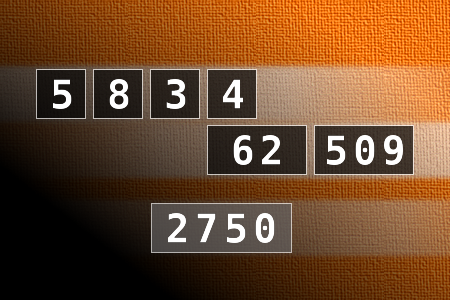
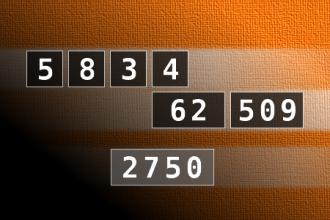
Calculate the number 2750
[4967] Calculate the number 2750 - NUMBERMANIA: Calculate the number 2750 using numbers [5, 8, 3, 4, 62, 509] and basic arithmetic operations (+, -, *, /). Each of the numbers can be used only once. - #brainteasers #math #numbermania - Correct Answers: 16 - The first user who solved this task is Djordje Timotijevic
BRAIN TEASERS
enter your answer and press button OK

Calculate the number 2750

NUMBERMANIA: Calculate the number 2750 using numbers [5, 8, 3, 4, 62, 509] and basic arithmetic operations (+, -, *, /). Each of the numbers can be used only once.
Correct answers: 16
The first user who solved this task is Djordje Timotijevic.
#brainteasers #math #numbermania
Register with your Google Account and start collecting points.
Check your ranking on list.

Pork at a July 4th Picnic

A priest and a rabbi met at the annual July 4th picnic. They were old friends and loved to tease one another. "This baked ham is really good,” said the priest. “You really ought to break down and try some.”"I will, I will,” replies the rabbi, smiling, “at your wedding.”
Jokes of the day - Daily updated jokes. New jokes every day.
Follow Brain Teasers on social networks

Brain Teasers

puzzles, riddles, mathematical problems, mastermind, cinemania...

Michael Idvorsky Pupin

Born 4 Oct 1858; died 12 Mar 1935 at age 76. Serbian-American physicist who devised a means of greatly extending the range of long-distance telephone communication by placing loading coils (of wire) at predetermined intervals along the transmitting wire. His parents were illiterate, but they encouraged his education. Pupin became an instructor in mathematical physics (1890) at Columbia University, New York City. In 1986, he discovered that atoms struck by X rays emit secondary X-ray radiation. He also invented a means for taking short-exposure X-ray photographs. The Bell Telephone Company, in 1901, acquired the patent for his invention for long-distance telephony. Pupin won a Pulitzer Prize (1924) for his autobiographical work, From Immigrant to Inventor (1923).
This site uses cookies to store information on your computer. Some are essential to help the site properly. Others give us insight into how the site is used and help us to optimize the user experience. See our privacy policy.