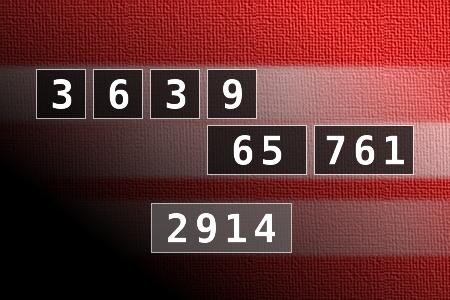
Calculate the number 2914
[7263] Calculate the number 2914 - NUMBERMANIA: Calculate the number 2914 using numbers [3, 6, 3, 9, 65, 761] and basic arithmetic operations (+, -, *, /). Each of the numbers can be used only once. - #brainteasers #math #numbermania - Correct Answers: 2
BRAIN TEASERS
enter your answer and press button OK

Calculate the number 2914

NUMBERMANIA: Calculate the number 2914 using numbers [3, 6, 3, 9, 65, 761] and basic arithmetic operations (+, -, *, /). Each of the numbers can be used only once.
Correct answers: 2
#brainteasers #math #numbermania
Register with your Google Account and start collecting points.
Check your ranking on list.

Praying for a Parking Space

A laywoman was driving down the street in a sweat because she had an important meeting and couldn’t find a parking space. Looking up toward heaven, she said, “Lord, take pity on me. If you find me a parking place I’ll go to Mass every Sunday for the rest of my life and give up drinking wine.”
Miraculously, a parking space opened up right in front of her destination.
The woman looked up to heaven and said, “Never mind, Lord; I found one on my own.”
Jokes of the day - Daily updated jokes. New jokes every day.
Follow Brain Teasers on social networks

Brain Teasers

puzzles, riddles, mathematical problems, mastermind, cinemania...

Eugène Freyssinet

Died 8 Jun 1962 at age 82 (born 13 Jul 1879).Marie-Eugène-Léon Freyssinet was a French civil engineer who successfully developed pre-stressed concrete, that is, concrete beams or girders in which steel wire is embedded under tension, greatly strengthening the concrete member. The prestressing technique was devised to overcome difficulties in executing curved shapes in reinforced concrete. More an engineer than an architect, Freyssinet began creating innovative architecture using reinforced concrete as his main material, such as airship hangars at Orly Airport, France (1921), bridges and industrial buildings. His first use of pre-stressed concrete was for the renovation of the transatlantic pier at Le Havre (1933-35).
This site uses cookies to store information on your computer. Some are essential to help the site properly. Others give us insight into how the site is used and help us to optimize the user experience. See our privacy policy.