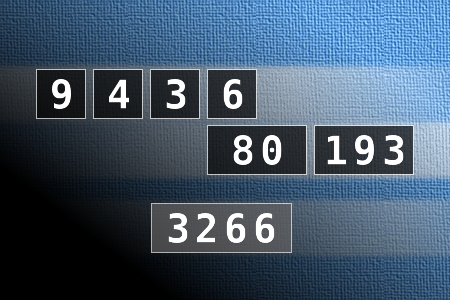

Calculate the number 3266
[5905] Calculate the number 3266 - NUMBERMANIA: Calculate the number 3266 using numbers [9, 4, 3, 6, 80, 193] and basic arithmetic operations (+, -, *, /). Each of the numbers can be used only once. - #brainteasers #math #numbermania - Correct Answers: 15 - The first user who solved this task is Nílton Corrêa De Sousa
BRAIN TEASERS
enter your answer and press button OK

Calculate the number 3266

NUMBERMANIA: Calculate the number 3266 using numbers [9, 4, 3, 6, 80, 193] and basic arithmetic operations (+, -, *, /). Each of the numbers can be used only once.
Correct answers: 15
The first user who solved this task is Nílton Corrêa De Sousa.
#brainteasers #math #numbermania
Register with your Google Account and start collecting points.
Check your ranking on list.

A man walks into a bar and orders a glass of 21-year-old whiskey...

A man walks into a bar and orders a glass of 21-year-old whiskey.

He takes a sip, then immediately spits it out.

“I asked for a 21-year-old whiskey! This is only 18 years. I’m not paying for this! Bring me a 12-year-old cognac instead.”

The bartender complies, but again, the man spits it out.

“This is only 10 years old! I’m not paying for that either!”

Frustrated after several rounds of the same routine, the bartender pours another drink and says,

"This one’s on the house."

The man takes a sip, spits it out once more.

"This tastes like piss!"

The bartender sighs and replies,

"Alright, genius, now guess how old I am?"

Jokes of the day - Daily updated jokes. New jokes every day.
Follow Brain Teasers on social networks

Brain Teasers

puzzles, riddles, mathematical problems, mastermind, cinemania...

James Beaumont Neilson

Died 18 Jan 1865 at age 72 (born 22 Jun 1792).Scottish inventor who introduced the use of a hot-air blast instead of a cold-air blast for the smelting of iron. His process reduced the amount of coal needed and increased efficiency to satisfy the demands of the rail and shipbuilding industries. While manager of the Glasgow Gas-works, he had experimented with the effect of heated air on the illuminating power of gas, by bringing up a stream of it in a tube so as to surround the gas burner. He found the combustion of the gas was more intense and brighter. Then, experimenting on a common smith's fire, by blowing the fire with heated air, the effect was the same; the fire was much more brilliant, and accompanied by an unusually intense degree of heat. In 1828, he patented his hot blast method for smelting.[Image: typical layout 1870's hot air blast furnace]
This site uses cookies to store information on your computer. Some are essential to help the site properly. Others give us insight into how the site is used and help us to optimize the user experience. See our privacy policy.