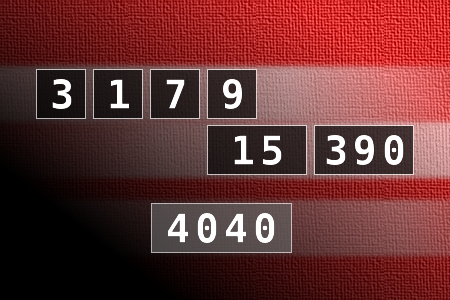
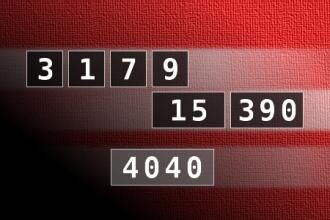
Calculate the number 4040
[6990] Calculate the number 4040 - NUMBERMANIA: Calculate the number 4040 using numbers [3, 1, 7, 9, 15, 390] and basic arithmetic operations (+, -, *, /). Each of the numbers can be used only once. - #brainteasers #math #numbermania - Correct Answers: 9 - The first user who solved this task is Nasrin 24 T
BRAIN TEASERS
enter your answer and press button OK

Calculate the number 4040

NUMBERMANIA: Calculate the number 4040 using numbers [3, 1, 7, 9, 15, 390] and basic arithmetic operations (+, -, *, /). Each of the numbers can be used only once.
Correct answers: 9
The first user who solved this task is Nasrin 24 T.
#brainteasers #math #numbermania
Register with your Google Account and start collecting points.
Check your ranking on list.

A family is at the dinner tabl...

A family is at the dinner table. The son asks his father, "Dad, how many kinds of boobies are there?
The father, surprised, answers, "Well, son, there's three kinds of breasts. In her twenties, a women's breasts are like melons, round and firm. In her thirties to forties, they are like pears, still nice but hanging a bit. After fifty, they are like onions."
"Onions?"
"Yes, you see them and they make you cry."
This infuriated his wife and daughter so the daughter said, "Mum, how many kinds of 'willies' are there?"
The mother, surprised, smiles and answers, "Well dear, a man goes through three phases. In his twenties, his willy is like an oak tree, mighty and hard. In his thirties and forties, it is a birch, flexible but reliable. After his fifties, it is like a Christmas tree."
"A Christmas tree?"
"Yes, dead from the root up and the balls are for decoration only."
Jokes of the day - Daily updated jokes. New jokes every day.
Follow Brain Teasers on social networks

Brain Teasers

puzzles, riddles, mathematical problems, mastermind, cinemania...

First typewriter patent

In 1714, the world's first patent for a “Machine for Transcribing Letters” was granted in England by Queen Anne to Henry Mill (1683?-1771), a waterworks engineer with the New River Company. The patent (No. 395) described the invention as “an artificial machine or method for impressing or transcribing of letters, one after another, as in writing, whereby all writing whatsoever may be engrossed in paper or parchment so neat and exact as not to be distinguished from print; that the said machine... may be of great use in settlements and publick recors, the impression being deeper and more lasting than any other writing, and not to be erased or counterfeited without manifest discovery.” There is no remaining record that he actually built the machine.«
This site uses cookies to store information on your computer. Some are essential to help the site properly. Others give us insight into how the site is used and help us to optimize the user experience. See our privacy policy.