
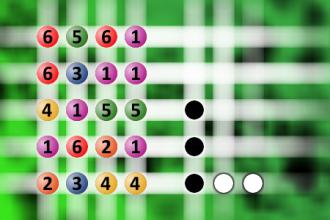
What a winning combination?
[6991] What a winning combination? - The computer chose a secret code (sequence of 4 digits from 1 to 6). Your goal is to find that code. Black circles indicate the number of hits on the right spot. White circles indicate the number of hits on the wrong spot. - #brainteasers #mastermind - Correct Answers: 28 - The first user who solved this task is Nasrin 24 T
BRAIN TEASERS
enter your answer and press button OK

What a winning combination?

The computer chose a secret code (sequence of 4 digits from 1 to 6). Your goal is to find that code. Black circles indicate the number of hits on the right spot. White circles indicate the number of hits on the wrong spot.
Correct answers: 28
The first user who solved this task is Nasrin 24 T.
#brainteasers #mastermind
Register with your Google Account and start collecting points.
Check your ranking on list.

There were three little boys v...

There were three little boys visiting their grandparents.
The oldest came out and asked his grandpa, "Can you make a sound like a frog, Grandpappy?
Grandpa (being in a kind of ill mood) responds, "No, I don't really want to make the sound of a frog now."
So, the second little boy comes out and asks his grandfather, "Will you please make a sound like a frog?"
Grandpa again says, "No, not now. I don't really want to do that.I'm in a grumpy mood. Maybe later."
Then the third little boy comes out and says, "Grandpa, oh please...Please, please will you make a sound like a frog?"
"Why do all of you boys want me to make a sound like a frog?" Grandpa asked.
The little boy replied with a hopeful face, "Well, Mom said that when you croak, we get to go to Disney World!"
Jokes of the day - Daily updated jokes. New jokes every day.
Follow Brain Teasers on social networks

Brain Teasers

puzzles, riddles, mathematical problems, mastermind, cinemania...

Paul Bartsch

Died 24 Apr 1960 at age 88 (born 14 Aug 1871). German-American zoologist who was an authority on molluscs, but had broad interests in natural history including plants and birds. He began his career as assistant curator of marine invertebrates at the US National Museum, Washington, DC., but then worked until retirement for the Smithsonian Institution (1896-1942). He represented that organisation on numerous zoological expeditions. In 1902, he initiated a systematic, scientific bird banding program (credited as the first in North America since John James Audubon) by banding 23 Black-crowned Night-herons at Washington, DC. During WW I, he invented a gas detector for the Chemical Warfare Service in 1918. Bartsch organized the first Boy Scout troop in Washington.«
This site uses cookies to store information on your computer. Some are essential to help the site properly. Others give us insight into how the site is used and help us to optimize the user experience. See our privacy policy.