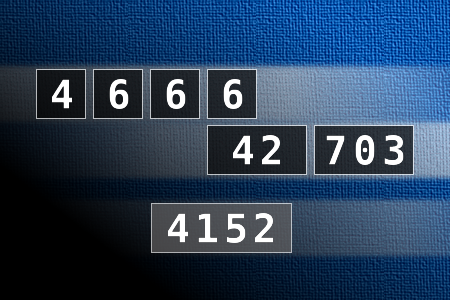
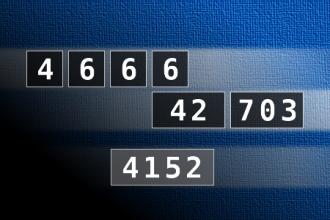
Calculate the number 4152
[8130] Calculate the number 4152 - NUMBERMANIA: Calculate the number 4152 using numbers [4, 6, 6, 6, 42, 703] and basic arithmetic operations (+, -, *, /). Each of the numbers can be used only once. - #brainteasers #math #numbermania - Correct Answers: 1
BRAIN TEASERS
enter your answer and press button OK

Calculate the number 4152

NUMBERMANIA: Calculate the number 4152 using numbers [4, 6, 6, 6, 42, 703] and basic arithmetic operations (+, -, *, /). Each of the numbers can be used only once.
Correct answers: 1
#brainteasers #math #numbermania
Register with your Google Account and start collecting points.
Check your ranking on list.

Talking Frog

A guy is 86 years old and loves to fish. He was sitting in his boat the other day when he heard a voice say,
"Pick me up."
He looked around and couldn't see any one. He thought he was dreaming when he heard the voice say again,
"Pick me up." He looked in the water and there, floating on the top was a frog.
The man said, "Are you talking to me?"
The frog said, "Yes, I'm talking to you. Pick me up.
Then, kiss me and I'll turn into the most beautiful woman you have ever seen.
I'll make sure that all your friends are envious and jealous because you will have me as your bride."
The man looked at the frog for a short time, reached over, picked it up carefully, and placed it in his front breast pocket.
Then the frog said, "What, are you nuts? Didn't you hear what I said?
I said kiss me and I will be your beautiful bride."
He opened his pocket, looked at the frog and said,
"Nah, at my age I'd rather have a talking frog."   

Jokes of the day - Daily updated jokes. New jokes every day.
Follow Brain Teasers on social networks

Brain Teasers

puzzles, riddles, mathematical problems, mastermind, cinemania...

Alexander Wetmore

Born 18 Jun 1886; died 7 Dec 1978 at age 92.Frank Alexander Wetmore was an American ornithologist, whose first name was never used, became a prominent ornithologist and avian paleontologist, noted for his research on birds of the Western Hemisphere. Between 1910 and 1924, he worked for with the U.S. Bureau of Biological Survey, Department of Agriculture. In 1925, he was appointed Assistant Secretary, head of the Smithsonian's U.S. National Museum. From 1945 to 1952, he served as the sixth Secretary of the Smithsonian Institution. Upon retiring, he continued his research at the Smithsonian Institution for another quarter century.
This site uses cookies to store information on your computer. Some are essential to help the site properly. Others give us insight into how the site is used and help us to optimize the user experience. See our privacy policy.