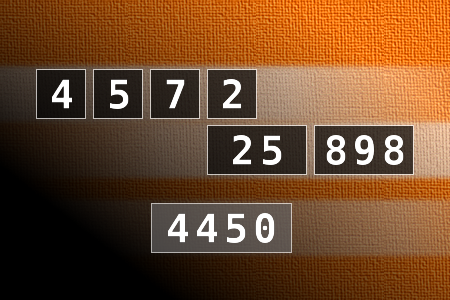
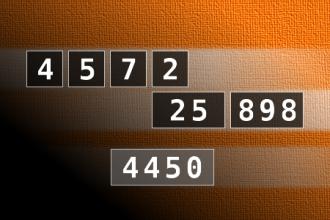
Calculate the number 4450
[6750] Calculate the number 4450 - NUMBERMANIA: Calculate the number 4450 using numbers [4, 5, 7, 2, 25, 898] and basic arithmetic operations (+, -, *, /). Each of the numbers can be used only once. - #brainteasers #math #numbermania - Correct Answers: 12 - The first user who solved this task is Nílton Corrêa de Sousa
BRAIN TEASERS
enter your answer and press button OK

Calculate the number 4450

NUMBERMANIA: Calculate the number 4450 using numbers [4, 5, 7, 2, 25, 898] and basic arithmetic operations (+, -, *, /). Each of the numbers can be used only once.
Correct answers: 12
The first user who solved this task is Nílton Corrêa de Sousa.
#brainteasers #math #numbermania
Register with your Google Account and start collecting points.
Check your ranking on list.

Family Bible

A little boy opened the big and old family Bible with fascination, looking at the old pages as he turned them. Then something fell out, and he picked it up and looked at it closely. It was an old leaf from a tree that had been pressed in between the pages.

“Momma, look what I found,” the boy called out.

“What have you got there, dear?” his mother asked.

With astonishment in the his voice, he answered, “It's Adam's Suit!”

Jokes of the day - Daily updated jokes. New jokes every day.
Follow Brain Teasers on social networks

Brain Teasers

puzzles, riddles, mathematical problems, mastermind, cinemania...

Giacobini-Zinner comet

In 1900, Michel Giacobini in France discovered a comet, which was rediscovered by a German, Ernst Zinner, on 23 Oct 1913, and since named the Giacobini-Zinner comet. It returns to the vicinity of the earth every six and two-thirds years. This comet became the first to be visited by a spacecraft. On 11 Sep 1985, the International Cometary Explorer (ICE) flew through its gas tail, 7,800-km downstream from the nucleus, at a speed of 21 km/sec. The nucleus was estimated to be 2.5-km across at its widest diameter. Instruments detected carbon monosulfide and hydroxyl molecules in the comet. The comet is the progenitor of the Draconid meteor shower, visible annually in early October, which produced intense meteor displays in 1933 and 1946.
This site uses cookies to store information on your computer. Some are essential to help the site properly. Others give us insight into how the site is used and help us to optimize the user experience. See our privacy policy.