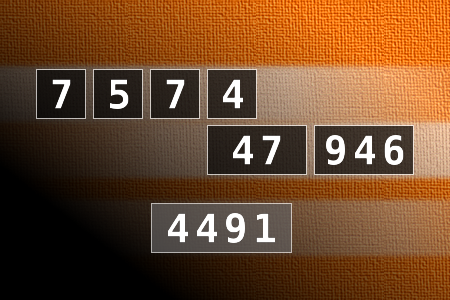
Calculate the number 4491
[8095] Calculate the number 4491 - NUMBERMANIA: Calculate the number 4491 using numbers [7, 5, 7, 4, 47, 946] and basic arithmetic operations (+, -, *, /). Each of the numbers can be used only once. - #brainteasers #math #numbermania - Correct Answers: 0
BRAIN TEASERS
enter your answer and press button OK

Calculate the number 4491

NUMBERMANIA: Calculate the number 4491 using numbers [7, 5, 7, 4, 47, 946] and basic arithmetic operations (+, -, *, /). Each of the numbers can be used only once.
Correct answers: 0
#brainteasers #math #numbermania
Register with your Google Account and start collecting points.
Check your ranking on list.

Cruise Control

My family has a tradition of naming the cruise control on our cars. We were used to hearing my father proclaim, “Take it, Max,” as he flipped on the cruise control during long trips in our station wagon.

Recently, I was travelling with my parents in their new car when we hit a wide-open expanse of highway. My dad leaned back and said, “I think I'll let Tom drive for a while.”

“Tom who?” I asked.

My mother translated for me: “Tom Cruise, of course.”

Jokes of the day - Daily updated jokes. New jokes every day.
Follow Brain Teasers on social networks

Brain Teasers

puzzles, riddles, mathematical problems, mastermind, cinemania...

Jacques-Salomon Hadamard

Died 17 Oct 1963 at age 97 (born 8 Dec 1865).French mathematician who proved the prime-number theorem (as n approaches infinity, the limit of the ratio of (n) and n/ln n is 1, where (n) is the number of positive prime numbers not greater than n). Conjectured in the 18th century, this theorem was not proved until 1896, when Hadamard and also Charles de la Vallée Poussin, used complex analysis. Hadamard's work includes the theory of integral functions and singularities of functions represented by Taylor series. His work on the partial differential equations of mathematical physics is important. He introduced the concept of a well-posed initial value and boundary value problem. In considering boundary value problems he introduced a generalisation of Green's functions (1932).
This site uses cookies to store information on your computer. Some are essential to help the site properly. Others give us insight into how the site is used and help us to optimize the user experience. See our privacy policy.