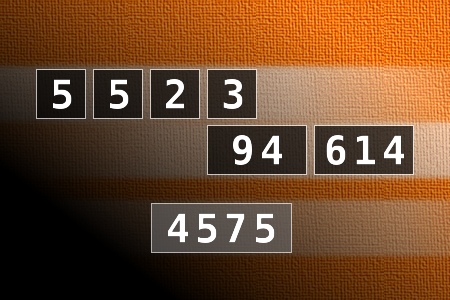
Calculate the number 4575
[5858] Calculate the number 4575 - NUMBERMANIA: Calculate the number 4575 using numbers [5, 5, 2, 3, 94, 614] and basic arithmetic operations (+, -, *, /). Each of the numbers can be used only once. - #brainteasers #math #numbermania - Correct Answers: 11 - The first user who solved this task is Thinh Ddh
BRAIN TEASERS
enter your answer and press button OK

Calculate the number 4575

NUMBERMANIA: Calculate the number 4575 using numbers [5, 5, 2, 3, 94, 614] and basic arithmetic operations (+, -, *, /). Each of the numbers can be used only once.
Correct answers: 11
The first user who solved this task is Thinh Ddh.
#brainteasers #math #numbermania
Register with your Google Account and start collecting points.
Check your ranking on list.

The secret of my success

Grandpa was celebrating his 100th birthday and everybody complimented him on how athletic and well-preserved he appeared.

"Gentlemen, I will tell you the secret of my success," he cackled. "I have been in the open air day after day for some 75 years now."

The celebrants were impressed and asked how he managed to keep up his rigorous fitness regime.

"Well, you see my wife and I were married 75 years ago. On our wedding night, we made a solemn pledge. Whenever we had a fight, the one who was proved wrong would go outside and take a walk."

Jokes of the day - Daily updated jokes. New jokes every day.
Follow Brain Teasers on social networks

Brain Teasers

puzzles, riddles, mathematical problems, mastermind, cinemania...

Hugh Newall

Born 21 Jun 1857; died 22 Feb 1944 at age 86. Hugh Frank Newall was an English astronomer and physicistwho held the first chair of astrophysics at Cambridge University (1909-1928). After teaching at Wellington College, he went to Cambridge to be an assistant to J. J. Thomson. He changed his interests from being senior demonstrator in experimental physics to astronomy when he facilitated the university's acquisition of the 25-inch Newall Telescope after the death of his father, Robert Stirling Newall, in 1889. His father, an engineer in manufacturing wire ropes and submarine telegraph cables, had the telescope built for private use at his Gateshead home. Hugh paid the moving expenses. When built, it was the largest in the world, and remained so for many years. He designed spectrographs and studied the solar corona, became director of the Solar Physics Observatory (1913) and led many eclipse expeditions.«
This site uses cookies to store information on your computer. Some are essential to help the site properly. Others give us insight into how the site is used and help us to optimize the user experience. See our privacy policy.