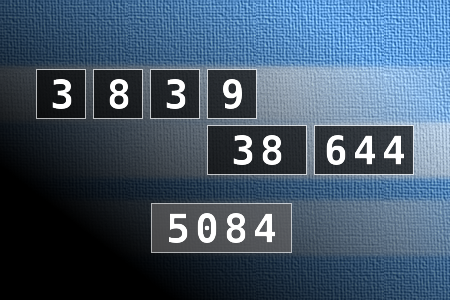

Calculate the number 5084
[4042] Calculate the number 5084 - NUMBERMANIA: Calculate the number 5084 using numbers [3, 8, 3, 9, 38, 644] and basic arithmetic operations (+, -, *, /). Each of the numbers can be used only once. - #brainteasers #math #numbermania - Correct Answers: 29 - The first user who solved this task is Djordje Timotijevic
BRAIN TEASERS
enter your answer and press button OK

Calculate the number 5084

NUMBERMANIA: Calculate the number 5084 using numbers [3, 8, 3, 9, 38, 644] and basic arithmetic operations (+, -, *, /). Each of the numbers can be used only once.
Correct answers: 29
The first user who solved this task is Djordje Timotijevic.
#brainteasers #math #numbermania
Register with your Google Account and start collecting points.
Check your ranking on list.

English School

Donald MacDonald from Scotland went to study at an English university and was living in the hall of residence with all the other students there. After he had been there a month, his mother came to visit him (no doubt carrying reinforcements of tatties, salt herring, oatmeal and whisky).

“And how do you find the English students, Donald?” she asked.

“Mother,” he replied, “they're such terrible, noisy people. The one on that side keeps banging his head on the wall and won't stop. The one on the other side screams and screams all night.”

“Oh Donald! How do you manage to put up with these awful noisy English neighbors?”

“Mother, I do nothing. I just ignore them. I just stay here quietly, playing my bagpipes.”

Jokes of the day - Daily updated jokes. New jokes every day.
Follow Brain Teasers on social networks

Brain Teasers

puzzles, riddles, mathematical problems, mastermind, cinemania...

Richard Roberts

Born 22 Apr 1789; died 16 Mar 1864 at age 74.Welsh mechanical engineer who was versatile in his creativity. One of his earliest inventions was the first successful gas meter. His first patent (1822) was for improvements in looms. He was one of the inventors of the first metal planing machines (1817). Roberts also developed a screw-cutting lathe, and machines for gearcutting and slotting. The self-acting spinning mule (1825) he invented was his most important contribution to the textile industry, which he also set up in France. In the 1830s, his firm built railway locomotives in one of the earliest applications of the use of interchangeable parts. In the 1840s he devised machinery for punching patterns of holes in bridge and boiler plate, automated using punched cards similar to the Jacquard loom.
This site uses cookies to store information on your computer. Some are essential to help the site properly. Others give us insight into how the site is used and help us to optimize the user experience. See our privacy policy.