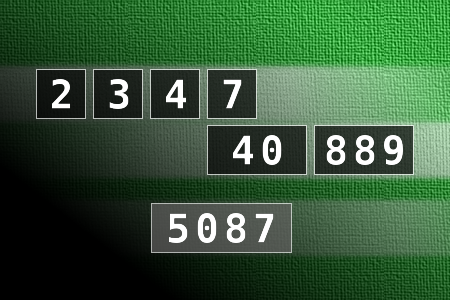
Calculate the number 5087
[5563] Calculate the number 5087 - NUMBERMANIA: Calculate the number 5087 using numbers [2, 3, 4, 7, 40, 889] and basic arithmetic operations (+, -, *, /). Each of the numbers can be used only once. - #brainteasers #math #numbermania - Correct Answers: 16 - The first user who solved this task is Djordje Timotijevic
BRAIN TEASERS
enter your answer and press button OK

Calculate the number 5087

NUMBERMANIA: Calculate the number 5087 using numbers [2, 3, 4, 7, 40, 889] and basic arithmetic operations (+, -, *, /). Each of the numbers can be used only once.
Correct answers: 16
The first user who solved this task is Djordje Timotijevic.
#brainteasers #math #numbermania
Register with your Google Account and start collecting points.
Check your ranking on list.

A man went to the Police Stati...

A man went to the Police Station wishing to speak with the burglar who had broken into his house the night before.
"You'll get your chance in court," said the Desk Sergeant.
"No, no, no!" said the man. "I want to know how he got into the house without waking my wife. I've been trying to do that for years!"
Jokes of the day - Daily updated jokes. New jokes every day.
Follow Brain Teasers on social networks

Brain Teasers

puzzles, riddles, mathematical problems, mastermind, cinemania...

Jakob Steiner

Born 18 Mar 1796; died 1 Apr 1863 at age 67.Swiss mathematician who was one of the greatest, contributors to projective geometry. He discovered the Steiner surface which has a double infinity of conic sections on it. The Steiner theorem states that the two pencils by which a conic is projected from two of its points are projectively related. He is also known for the Poncelet-Steiner theorem which shows that only one given circle and a straight edge are required for Euclidean constructions. His work included conic sections and surfaces, the theory of second-degree surfaces and centre-of-gravity problems. He developed the principle of symmetrization (1840-41). In 1848 he ws the first to define various polar curves with respect to a given curve, and introduced the “Steiner Curves.”«
This site uses cookies to store information on your computer. Some are essential to help the site properly. Others give us insight into how the site is used and help us to optimize the user experience. See our privacy policy.