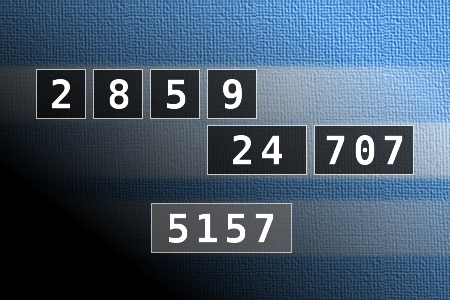

Calculate the number 5157
[7647] Calculate the number 5157 - NUMBERMANIA: Calculate the number 5157 using numbers [2, 8, 5, 9, 24, 707] and basic arithmetic operations (+, -, *, /). Each of the numbers can be used only once. - #brainteasers #math #numbermania - Correct Answers: 1
BRAIN TEASERS
enter your answer and press button OK

Calculate the number 5157

NUMBERMANIA: Calculate the number 5157 using numbers [2, 8, 5, 9, 24, 707] and basic arithmetic operations (+, -, *, /). Each of the numbers can be used only once.
Correct answers: 1
#brainteasers #math #numbermania
Register with your Google Account and start collecting points.
Check your ranking on list.

The secret of my success

Grandpa was celebrating his 100th birthday and everybody complimented him on how athletic and well-preserved he appeared.

"Gentlemen, I will tell you the secret of my success," he cackled. "I have been in the open air day after day for some 75 years now."

The celebrants were impressed and asked how he managed to keep up his rigorous fitness regime.

"Well, you see my wife and I were married 75 years ago. On our wedding night, we made a solemn pledge. Whenever we had a fight, the one who was proved wrong would go outside and take a walk."

Jokes of the day - Daily updated jokes. New jokes every day.
Follow Brain Teasers on social networks

Brain Teasers

puzzles, riddles, mathematical problems, mastermind, cinemania...

Albert Sauveur

Born 21 Jun 1863; died 26 Jan 1939 at age 75.Belgian-born American metallurgist whose microscopic and photomicroscopic studies of metal structures make him one of the founders of physical metallurgy. In 1891 he began working with the South Chicago works of the Illinois Steel Company where, to follow his ideas, he was provided with a microscope and a room to work in. "This small beginning," Sauveur later wrote, "marked the introduction of metallography into the iron and steel industry of the United States." He is best known for his research on the hardening of steel (1893) that "the properties of steel rails were largely dependent on the dimensions of their microscopical constituents or grain sizes, and that in turn these dimensions resulted chiefly from the finishing temperatures."
This site uses cookies to store information on your computer. Some are essential to help the site properly. Others give us insight into how the site is used and help us to optimize the user experience. See our privacy policy.