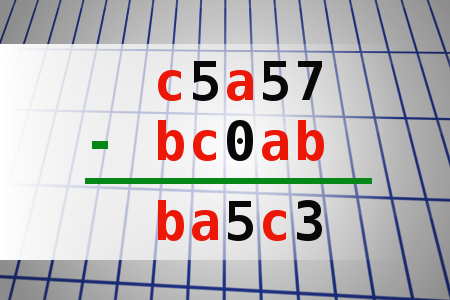
Find number abc
[7648] Find number abc - If c5a57 - bc0ab = ba5c3 find number abc. Multiple solutions may exist. - #brainteasers #math - Correct Answers: 4
BRAIN TEASERS
enter your answer and press button OK

Find number abc

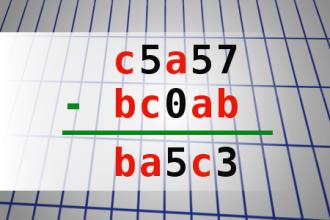
If c5a57 - bc0ab = ba5c3 find number abc. Multiple solutions may exist.
Correct answers: 4
#brainteasers #math
Register with your Google Account and start collecting points.
Check your ranking on list.

Lumberyard

Jon's working at the lumberyard, pushing a tree through the buzz saw, and accidentally shears off all ten of his fingers. He goes to the emergency room.
The doctor says, "Yuck! Well, give me the fingers, and I'll see what I can do."
Jon says, "I haven't got the fingers."
The doctor says, "What do you mean, you haven't got the fingers? It's 1999. We've got microsurgery and all kinds of incredible techniques. I could have put them back on and made you like new. Why didn't you bring the fingers?"
Jon says, "Well, sh*t, Doc, I couldn't pick 'em up."    

Jokes of the day - Daily updated jokes. New jokes every day.
Follow Brain Teasers on social networks

Brain Teasers

puzzles, riddles, mathematical problems, mastermind, cinemania...

Richard Christopher Carrington

Born 26 May 1826; died 27 Nov 1875 at age 49.English astronomer who, by observing the motionsp of sunspots, discovered the equatorial acceleration of the Sun; i.e., that it rotates faster at the equator than near the poles. He also discovered the movement of sunspot zones toward the Sun's equator as the solar cycle progresses. Carrington devoted himself to the study of sunspots and his work, extending from 1853 to 1861, was collected in Observation of the Spots of the Sun (1863). Carrington also was the first to observe a sun flare (1859). He was observing a prominent group of sunspots on 1 Sep 1859, when suddenly "two patches of intensely bright and white light broke out." which brightened rapidly and decayed. The flare he had seen was of the rare variety that is visible in white light.(Image: detail of a drawing by R.C. Carrington, showing the location of the flare he observed while making a drawing of an active region. Reproduced from his 1860 paper in Monthly Notices of the Royal Astronomical Society)
This site uses cookies to store information on your computer. Some are essential to help the site properly. Others give us insight into how the site is used and help us to optimize the user experience. See our privacy policy.