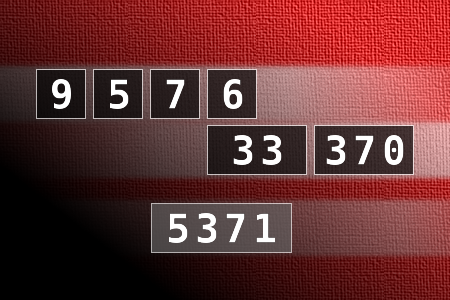
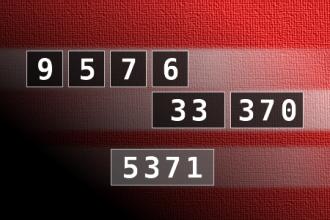
Calculate the number 5371
[7778] Calculate the number 5371 - NUMBERMANIA: Calculate the number 5371 using numbers [9, 5, 7, 6, 33, 370] and basic arithmetic operations (+, -, *, /). Each of the numbers can be used only once. - #brainteasers #math #numbermania - Correct Answers: 1
BRAIN TEASERS
enter your answer and press button OK

Calculate the number 5371

NUMBERMANIA: Calculate the number 5371 using numbers [9, 5, 7, 6, 33, 370] and basic arithmetic operations (+, -, *, /). Each of the numbers can be used only once.
Correct answers: 1
#brainteasers #math #numbermania
Register with your Google Account and start collecting points.
Check your ranking on list.

Hymns By Word Association

A minister decided to do something a little different one Sunday morning. He said, "Today, in church, I am going to say a single word and you are going to help me preach. Whatever single word I say, I want you to sing whatever hymn comes to your mind."The pastor shouted out, "Cross!" Immediately the congregation started singing, in unison, "The Old Rugged Cross." The pastor hollered out, "Grace!" The congregation began to sing "Amazing Grace, how sweet the sound..." The pastor said, "Power." The congregation sang "There Is Power in the Blood." The Pastor said, "Sex." The congregation fell in total silence. Everyone was in shock. They all nervously began to look around at each other, afraid to say anything. Then all of a sudden, way from in the back of the church, a little old 87-year-old grandmother stood up and began to sing "Precious Memories."
Jokes of the day - Daily updated jokes. New jokes every day.
Follow Brain Teasers on social networks

Brain Teasers

puzzles, riddles, mathematical problems, mastermind, cinemania...

Daniel Nathans

Died 16 Nov 1999 at age 71 (born 30 Oct 1928).American microbiologist, corecipient of the Nobel Prize for Physiology or Medicine in 1978 (with American Hamilton Othanel Smith and Swiss scientist Werner Arber). The winners were cited for their discovery and application of restriction enzymes, which provide the "chemical knives" to cut genes (= DNA) into defined fragments. These may then be used (1) to determine the order of genes on chromosomes, (2) to analyse the chemical structure of genes and of regions of DNA which regulate the function of genes, and (3) to create new combinations of genes. Thus new avenues are opened to study the basic problems in developmental biology; and in medicine, to help the prevention and treatment of malformations, hereditary diseases and cancer.
This site uses cookies to store information on your computer. Some are essential to help the site properly. Others give us insight into how the site is used and help us to optimize the user experience. See our privacy policy.