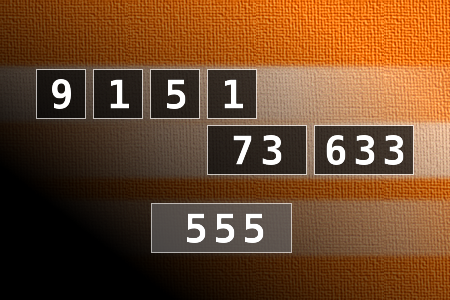
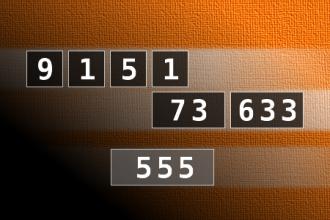
Calculate the number 555
[5713] Calculate the number 555 - NUMBERMANIA: Calculate the number 555 using numbers [9, 1, 5, 1, 73, 633] and basic arithmetic operations (+, -, *, /). Each of the numbers can be used only once. - #brainteasers #math #numbermania - Correct Answers: 25 - The first user who solved this task is Djordje Timotijevic
BRAIN TEASERS
enter your answer and press button OK

Calculate the number 555

NUMBERMANIA: Calculate the number 555 using numbers [9, 1, 5, 1, 73, 633] and basic arithmetic operations (+, -, *, /). Each of the numbers can be used only once.
Correct answers: 25
The first user who solved this task is Djordje Timotijevic.
#brainteasers #math #numbermania
Register with your Google Account and start collecting points.
Check your ranking on list.

A boy was assigned a paper on...

A boy was assigned a paper on childbirth and asked his parents, "How was I born?"
"Well honey..." said the slightly prudish parent. "The stork brought you to us."
"Ohh..." said the boy. "Well, how did you and daddy get born?" he asked.
"Oh, your grandparents found us under a rock."
"Well how were grandpa and grandma born?" he persisted.
"Well darling, they were found under a cabbage leaf," said the parent.
Several days later, the boy handed in his paper to the teacher who read with confusion the opening sentence: "This report has been very difficult to write due to the fact that there hasn't been a natural childbirth in my family for three generations."
Jokes of the day - Daily updated jokes. New jokes every day.
Follow Brain Teasers on social networks

Brain Teasers

puzzles, riddles, mathematical problems, mastermind, cinemania...

John Keill

Born 1 Dec 1671; died 31 Aug 1721 at age 49.Scottish mathematician and natural philosopher, who was a major proponent of Newton's theories. He began his university education at Edinburgh under David Gregory, whom he followed to Oxford, where Keill lectured on Newton's work, and eventually became professor of astronomy. In his book, An Examination of Dr. Burnett's Theory of the Earth (1698), Keill applied Newtonian principles challenging Burnett's unsupportable speculations on Earth's formation. In 1701, Keill published Introductio ad Veram Physicam, which was the first series of experimental lectures and provided a clear and influential introduction to Isaac Newton's Principia. He supported Newton against priority claims by Leibnitz for the invention of calculus. (James Keill was his younger brother.)«
This site uses cookies to store information on your computer. Some are essential to help the site properly. Others give us insight into how the site is used and help us to optimize the user experience. See our privacy policy.