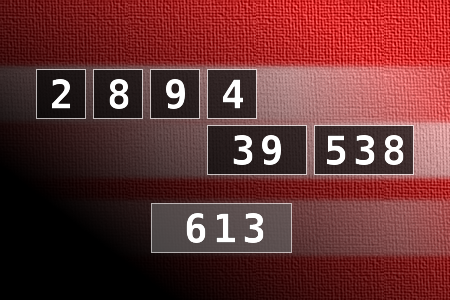
Calculate the number 613
[6170] Calculate the number 613 - NUMBERMANIA: Calculate the number 613 using numbers [2, 8, 9, 4, 39, 538] and basic arithmetic operations (+, -, *, /). Each of the numbers can be used only once. - #brainteasers #math #numbermania - Correct Answers: 17 - The first user who solved this task is Nílton Corrêa de Sousa
BRAIN TEASERS
enter your answer and press button OK

Calculate the number 613

NUMBERMANIA: Calculate the number 613 using numbers [2, 8, 9, 4, 39, 538] and basic arithmetic operations (+, -, *, /). Each of the numbers can be used only once.
Correct answers: 17
The first user who solved this task is Nílton Corrêa de Sousa.
#brainteasers #math #numbermania
Register with your Google Account and start collecting points.
Check your ranking on list.

What's the trick?

A man went to the police station wishing to speak with the burglar who had broken into his house the night before.

"You'll get your chance in court," said the desk sergeant.

"No, no, no!" insisted the man. "I want to know how he got into the house without waking my wife. I've been trying to do that for years!"

Jokes of the day - Daily updated jokes. New jokes every day.
Follow Brain Teasers on social networks

Brain Teasers

puzzles, riddles, mathematical problems, mastermind, cinemania...

Robert Schrieffer

Born 31 May 1931.John Robert Schrieffer is an American physicist whoshared(with John Bardeen and Leon N. Cooper) the 1972 Nobel Prize for Physics for developing the BCS theory (for their initials), the first successful microscopic theory of superconductivity. Although first described by Kamerlingh Onnes (1911), no theoretical explanation had been accepted. It explains how certain metals and alloys lose all resistance to electrical current at extremely low temperatures. The insight of the BCS theory is that at very low temperatures, under certain conditions, electrons can form bound pairs (Cooper pairs). This pair of electrons acts as a single particle in superconductivity. Schrieffer continued to focus his research on particle physics, metal impurities, spin fluctuations, and chemisorption.
This site uses cookies to store information on your computer. Some are essential to help the site properly. Others give us insight into how the site is used and help us to optimize the user experience. See our privacy policy.