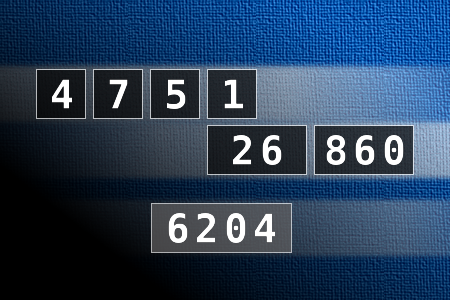
Calculate the number 6204
[7785] Calculate the number 6204 - NUMBERMANIA: Calculate the number 6204 using numbers [4, 7, 5, 1, 26, 860] and basic arithmetic operations (+, -, *, /). Each of the numbers can be used only once. - #brainteasers #math #numbermania - Correct Answers: 1
BRAIN TEASERS
enter your answer and press button OK

Calculate the number 6204

NUMBERMANIA: Calculate the number 6204 using numbers [4, 7, 5, 1, 26, 860] and basic arithmetic operations (+, -, *, /). Each of the numbers can be used only once.
Correct answers: 1
#brainteasers #math #numbermania
Register with your Google Account and start collecting points.
Check your ranking on list.

Halls Of Justice

A judge was annoyed to find that his car wouldn't start. He called a taxi, and soon one arrived at his house.
Climbing in, he told the driver to take him to the halls of justice. "Where are they," asked the driver.
"You mean to say that you don't know where the courthouse is?" asked the incredulous judge.
"The courthouse? Of course I know where that is." replied the driver. "But I thought you said you wanted to go to the 'halls of justice.'"
Jokes of the day - Daily updated jokes. New jokes every day.
Follow Brain Teasers on social networks

Brain Teasers

puzzles, riddles, mathematical problems, mastermind, cinemania...

Julius Arthur Nieuwland

Died 11 Jun 1936 at age 58 (born 14 Feb 1878).Belgian-American organic chemist who studied reactions of acetylene and invented neoprene. He was ordained as a priest (1903) before earning his Ph.D. (1904). He did not pursue his own discovery of the reaction between acetylene and arsenic trichloride, but it led to the development of the chemical-warfare agent lewisite dubbed “the dew of death”, a poison gas and vesicant used in WW I. He collaborated with DuPont chemists in thepolymerization of acetylene and development of chloroprene, which in turn could be polymerized to the first really successful synthetic rubber, neoprene. This was superior to rubber in many ways such as in its resistance to sunlight, abrasion, and temperature extremes.
This site uses cookies to store information on your computer. Some are essential to help the site properly. Others give us insight into how the site is used and help us to optimize the user experience. See our privacy policy.