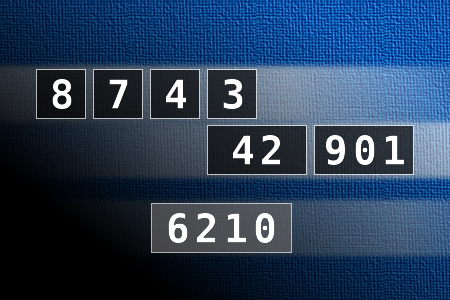
Calculate the number 6210
[5325] Calculate the number 6210 - NUMBERMANIA: Calculate the number 6210 using numbers [8, 7, 4, 3, 42, 901] and basic arithmetic operations (+, -, *, /). Each of the numbers can be used only once. - #brainteasers #math #numbermania - Correct Answers: 15 - The first user who solved this task is Djordje Timotijevic
BRAIN TEASERS
enter your answer and press button OK

Calculate the number 6210

NUMBERMANIA: Calculate the number 6210 using numbers [8, 7, 4, 3, 42, 901] and basic arithmetic operations (+, -, *, /). Each of the numbers can be used only once.
Correct answers: 15
The first user who solved this task is Djordje Timotijevic.
#brainteasers #math #numbermania
Register with your Google Account and start collecting points.
Check your ranking on list.

They Cheated

Once two star football players had failed a test, and could not play football in the championship game.
So, after much begging from the coach, the teacher finally let the two take the test again.
They took the test, and turned it in.
The coach and the two students watched carefully over the teacher grading the tests. She checked over the first test, then over the second test. Half way through the second test she stopped and put a great big 'F' on both tests.
The coach was furious and demanded an explanation. She said that they had cheated. 'Why?' the coach asked.
The teacher showed him number six. The coach looked at number six on the first test.
The answer read 'I don't know.' The coach said that it did not prove anything.
The teacher handed him the second test. The answer read 'I don't know either.'

Jokes of the day - Daily updated jokes. New jokes every day.
Follow Brain Teasers on social networks

Brain Teasers

puzzles, riddles, mathematical problems, mastermind, cinemania...

J. Willard Gibbs

Died 28 Apr 1903 at age 64 (born 11 Feb 1839). Josiah Willard Gibbs was an American mathematical physicist and chemist known for contributions to vector analysis and as one of the founders of physical chemistry. In 1863, He was awarded Yale University's first engineering doctorate degree. His major work was in developing thermodynamic theory, which brought physical chemistry from an empirical enquiry to a deductive science. In 1873, he published two papers concerning the fundamental nature of entropy of a system, and established the “thermodynamic surface,” a geometrical and graphical method for the analysis of the thermodynamic properties of substances. His famous On the Equilibrium of Homogeneous Substances, published in 1876, established the use of “chemical potential,” now an important concept in physical chemistry.«
This site uses cookies to store information on your computer. Some are essential to help the site properly. Others give us insight into how the site is used and help us to optimize the user experience. See our privacy policy.