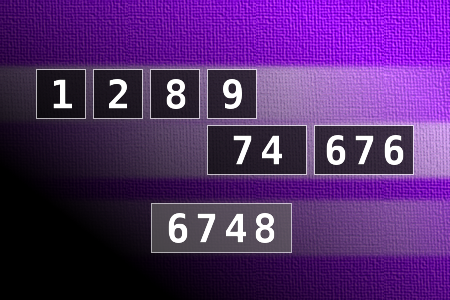

Calculate the number 6748
[6627] Calculate the number 6748 - NUMBERMANIA: Calculate the number 6748 using numbers [1, 2, 8, 9, 74, 676] and basic arithmetic operations (+, -, *, /). Each of the numbers can be used only once. - #brainteasers #math #numbermania - Correct Answers: 10 - The first user who solved this task is Nasrin 24 T
BRAIN TEASERS
enter your answer and press button OK

Calculate the number 6748

NUMBERMANIA: Calculate the number 6748 using numbers [1, 2, 8, 9, 74, 676] and basic arithmetic operations (+, -, *, /). Each of the numbers can be used only once.
Correct answers: 10
The first user who solved this task is Nasrin 24 T.
#brainteasers #math #numbermania
Register with your Google Account and start collecting points.
Check your ranking on list.

Welfare Office

A woman went down to the Welfare Office to get aid.

The office worker asked her, "How many children do you have?"

"Ten," she replied.

"What are their names?" he asked.

"David, David, David, David, David, David, David, David, David and David," she answered.

"They're all named David?" he asked "What if you want them to come in from playing outside?"

"Oh, that's easy," she said. "I just call 'David,' and they all come running in."

"And, if you want them to come to the table for dinner?"

"I just say, 'David, come eat your dinner'," she answered.

"But what if you just want ONE of them to do something?" he asked.

"Oh, that's easy," she said. "I just use their last name!"

Jokes of the day - Daily updated jokes. New jokes every day.
Follow Brain Teasers on social networks

Brain Teasers

puzzles, riddles, mathematical problems, mastermind, cinemania...

Mars Climate Orbiter

In 1998, the Mars Climate Orbiter was successfully launched on a Delta II rocket from Cape Canaveral Air Station in Florida. However, the probe disappeared on 23 Sep 1999, apparently destroyed because scientists had failed to convert English measures to metric values. The orbiter's instruments would have monitored the Martian atmosphere and image the planet's surface on a daily basis for one Martian year (1.8 Earth years) with observations of the appearance and movement of atmospheric dust and water vapor, as well as characterizing seasonal changes on the surface. Images of the surface features could provide important clues to the planet's early climate history and possible subsurface liquid water reserves.
This site uses cookies to store information on your computer. Some are essential to help the site properly. Others give us insight into how the site is used and help us to optimize the user experience. See our privacy policy.