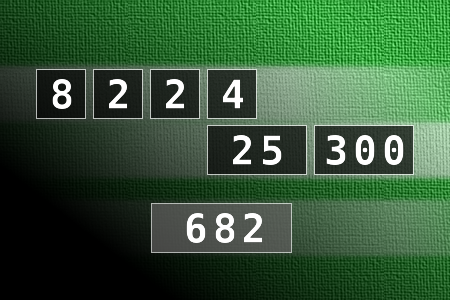

Calculate the number 682
[6163] Calculate the number 682 - NUMBERMANIA: Calculate the number 682 using numbers [8, 2, 2, 4, 25, 300] and basic arithmetic operations (+, -, *, /). Each of the numbers can be used only once. - #brainteasers #math #numbermania - Correct Answers: 12 - The first user who solved this task is Fazil Hashim
BRAIN TEASERS
enter your answer and press button OK

Calculate the number 682

NUMBERMANIA: Calculate the number 682 using numbers [8, 2, 2, 4, 25, 300] and basic arithmetic operations (+, -, *, /). Each of the numbers can be used only once.
Correct answers: 12
The first user who solved this task is Fazil Hashim.
#brainteasers #math #numbermania

Register with your Google Account and start collecting points.
Check your ranking on list.

The loan

Before going to Europe on business, a man drove his Rolls-Royce to a downtown New York City bank and went in to ask for an immediate loan of $5,000.

The bank officer says the bank will need some kind of security for such a loan. So the businessman hands over the keys to a Rolls-Royce parked on the street in front of the bank. Everything checks out, and the bank agrees to accept the car as collateral for the loan. An employee drives the Rolls into the bank's underground garage and parks it there.

Two weeks later, the businessman returns, repays the $5,000 and the interest, which comes to $15.40. The loan officer says, "We are very happy to have had your business, and this transaction has worked out very nicely, but we are a little puzzled. While you were away, we checked you out and found that you are a multimillionaire. What puzzles us is: why would you bother to borrow $5,000?"

The man smiled. "Where else could I park my Rolls-Royce in Manhattan for two weeks and pay only $15.40?"

Jokes of the day - Daily updated jokes. New jokes every day.
Follow Brain Teasers on social networks

Brain Teasers

puzzles, riddles, mathematical problems, mastermind, cinemania...

Henry Rowe Schoolcraft

Born 28 Mar 1793; died 10 Dec 1864 at age 71.American explorer and ethnologist noted for his discovery of the source of the Mississippi River (1832) in a lake in northern Minnesota which he named Lake Itasca, from the Latin words caput (head) and veritas (true). His early interest was rocks and minerals, which led to a geological survey expedition, then employment as a map-maker and government agent on the Northwest Frontier, near Lake Superior. He became interested in Native Americans and from these studies wrote about their history, language, mythology, hieroglyphics, picture writing, maxims, characteristics and potential, religious beliefs, and influence of Christian missionaries. Further, he addressed the past and future roles of the federal government and the Indian.
This site uses cookies to store information on your computer. Some are essential to help the site properly. Others give us insight into how the site is used and help us to optimize the user experience. See our privacy policy.