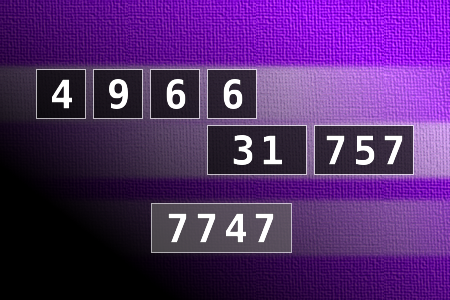
Calculate the number 7747
[3696] Calculate the number 7747 - NUMBERMANIA: Calculate the number 7747 using numbers [4, 9, 6, 6, 31, 757] and basic arithmetic operations (+, -, *, /). Each of the numbers can be used only once. - #brainteasers #math #numbermania - Correct Answers: 24 - The first user who solved this task is Fazil Hashim
BRAIN TEASERS
enter your answer and press button OK

Calculate the number 7747

NUMBERMANIA: Calculate the number 7747 using numbers [4, 9, 6, 6, 31, 757] and basic arithmetic operations (+, -, *, /). Each of the numbers can be used only once.
Correct answers: 24
The first user who solved this task is Fazil Hashim.
#brainteasers #math #numbermania
Register with your Google Account and start collecting points.
Check your ranking on list.

I Am Not Forgetful

Three ladies were discussing the travails of getting older. One said, "Sometimes I catch myself with a jar of mayonnaise in my hand, while standing in front of the refrigerator, and I can't remember whether I need to put it away, or start making a sandwich."
The second lady chimed in with, "Yes, sometimes I find myself on the landing of the stairs and can't remember whether I was on my way up or on my way down."
The third one responded, " Well, ladies, I'm glad I don't have that problem. Knock on wood," as she rapped her knuckles on the table, and then said, "That must be the door, I'll get it!"
Jokes of the day - Daily updated jokes. New jokes every day.
Follow Brain Teasers on social networks

Brain Teasers

puzzles, riddles, mathematical problems, mastermind, cinemania...

Norman Ramsey

Born 27 Aug 1915; died 4 Nov 2011 at age 96. Norman Foster Ramsey was an American physicist who shared (with Wolfgang Paul and Hans Georg Dehmelt) the 1989 Nobel Prize for Physics in 1989 for “for the invention of the separated oscillatory fields method and its use in the hydrogen maser and other atomic clocks.” His work produced a more precise way to observe the transitions within an atom switching from one specific energy level to another. In the cesium atomic clock, his method enables observing the transitions between two very closely spaced levels (hyperfine levels). The accuracy of such a clock is about one part in ten thousand billion. In 1967, one second was defined as the time during which the cesium atom makes exactly 9,192,631,770 oscillations.«
This site uses cookies to store information on your computer. Some are essential to help the site properly. Others give us insight into how the site is used and help us to optimize the user experience. See our privacy policy.