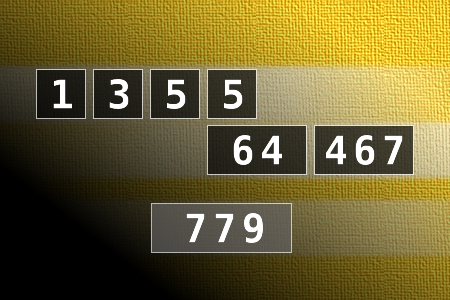
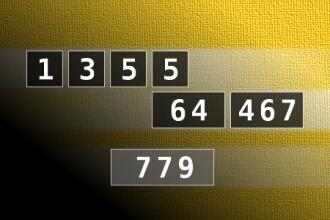
Calculate the number 779
[7858] Calculate the number 779 - NUMBERMANIA: Calculate the number 779 using numbers [1, 3, 5, 5, 64, 467] and basic arithmetic operations (+, -, *, /). Each of the numbers can be used only once. - #brainteasers #math #numbermania - Correct Answers: 3
BRAIN TEASERS
enter your answer and press button OK

Calculate the number 779

NUMBERMANIA: Calculate the number 779 using numbers [1, 3, 5, 5, 64, 467] and basic arithmetic operations (+, -, *, /). Each of the numbers can be used only once.
Correct answers: 3
#brainteasers #math #numbermania
Register with your Google Account and start collecting points.
Check your ranking on list.

Dream job

Reaching the end of a job interview, the Human Resources Person asked the young programmer, "And what starting salary were you looking for?"

The programmer said, "In the neighborhood of $75,000 a year, depending on the benefit's package."

The HR Person said, "Well, what would you say to a package of 5 weeks vacation, 14 paid holidays, full medical and dental, company matching retirement fund to 50% of salary, and a company Corvette leased every 2 years?"

The programmer sat up straight and said, "Wow!!! Are you kidding?"

The HR Person replied, "Certainly, ...but you started it."

Jokes of the day - Daily updated jokes. New jokes every day.
Follow Brain Teasers on social networks

Brain Teasers

puzzles, riddles, mathematical problems, mastermind, cinemania...

Heinrich Barkhausen

Died 20 Feb 1956 at age 74 (born 2 Dec 1881).Heinrich Georg Barkhausen was a German physicist who discovered the Barkhausen effect (1919), a principle concerning changes in the magnetic properties of metal. His work in acoustics and magnetism led to the discovery that magnetization affects whole domains of a ferromagnetic material, rather than individual atoms alone. He discovered that a slow, smooth increase of a magnetic field applied to a piece of ferromagnetic material, such as iron, causes it to become magnetized, not continuously but in minute steps. With Karl Kurz, he developed the Barkhausen- Kurz oscillator (1920) for ultrahigh frequencies (forerunner of the microwave tube), leading to understanding of the principle of velocity modulation. He is also known for experiments on shortwave radio transmissions.
This site uses cookies to store information on your computer. Some are essential to help the site properly. Others give us insight into how the site is used and help us to optimize the user experience. See our privacy policy.