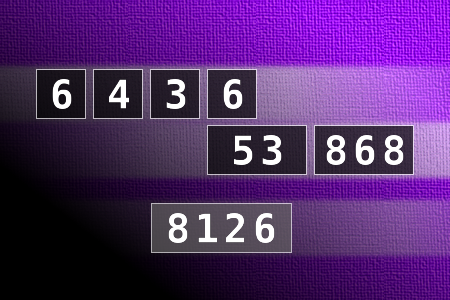
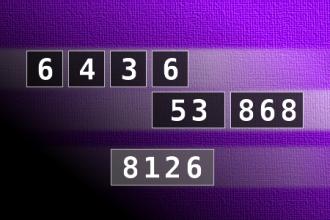
Calculate the number 8126
[5661] Calculate the number 8126 - NUMBERMANIA: Calculate the number 8126 using numbers [6, 4, 3, 6, 53, 868] and basic arithmetic operations (+, -, *, /). Each of the numbers can be used only once. - #brainteasers #math #numbermania - Correct Answers: 15 - The first user who solved this task is Djordje Timotijevic
BRAIN TEASERS
enter your answer and press button OK

Calculate the number 8126

NUMBERMANIA: Calculate the number 8126 using numbers [6, 4, 3, 6, 53, 868] and basic arithmetic operations (+, -, *, /). Each of the numbers can be used only once.
Correct answers: 15
The first user who solved this task is Djordje Timotijevic.
#brainteasers #math #numbermania
Register with your Google Account and start collecting points.
Check your ranking on list.

The Monastery on a Cliff

There is a story about a monastery perched high on a cliff several hundred feet in the air. The only way to reach the monastery was to be suspended in a basket which was pulled to the top by several monks who pulled and tugged with all their strength. Obviously the ride up the steep cliff in that basket was terrifying. One tourist got exceedingly nervous about half-way up as he noticed that the rope by which he was suspended was old and frayed. With trembling voice, he asked the monk who was riding with him in the basket how often they changed the rope.
The monk thought for a moment and answered brusquely, "Whenever it breaks."
Jokes of the day - Daily updated jokes. New jokes every day.
Follow Brain Teasers on social networks

Brain Teasers

puzzles, riddles, mathematical problems, mastermind, cinemania...

Gilbert Newton Lewis

Died 23 Mar 1946 at age 70 (born 23 Oct 1875). American chemist who collaborated with Irving Langmuir in developing an atomic theory. He developed a theory of valency, which introduced the covalent bond (c. 1916), whereby a chemical combination is made between two atoms by the sharing of a pair of electrons, one contributed from each atom. This was part of his more general octet theory, published in Valence and the Structure of Atoms and Molecules (1923). Lewis visualized the electrons in an atom as being arranged in concentric cubes. The sharing of these electrons he illustrated in the Lewis dot diagrams familiar to chemistry students. He generalized the concept of acids and bases now known as Lewis acids and Lewis bases.«
This site uses cookies to store information on your computer. Some are essential to help the site properly. Others give us insight into how the site is used and help us to optimize the user experience. See our privacy policy.